
Thanks for visiting Access Norton
- Guest view limit reached
- Create a free account (more details)
- Already a member? Click here to login
You are using an out of date browser. It may not display this or other websites correctly.
You should upgrade or use an alternative browser.
You should upgrade or use an alternative browser.
Fuse 35amp melted holder, why did it not blow?
- Thread starter auldblue
- Start date
- Status
- Not open for further replies.


- Joined
- Nov 20, 2004
- Messages
- 21,112

Mr.Sparks said:Well the fuse is rated at 35 amps, the holder somewhat less. Not sure if 35 amps is the right fuse, none of the wiring is rated that high.
The point is, is it 35A blow (in which case it's 17A continuous and is the correct fuse rating) or 35A continuous (which is 70A blow).
http://www.groups.tr-register.co.uk/nen ... 20BUSS.pdf

- Joined
- Nov 20, 2012
- Messages
- 1,200
Well , I was kind off thinking along those lines but I bought them in an auto parts store and the pack just said 35amp glass car fuse . I have since bought fuses from the green spark plug co and the look meatier than the one in the photo , can't find them. But I recon that pretty much makes sense and answers the question however I have used these fuses and they have blown in the past.
I have just replaced the warning light assimilater ( old one fouling on the new tank) with an after market one that fits in the headlight and a DP oil warning light and have taken the feed for that from the warning light in the shell. Now I have lost the fuse and at the moment all I have is a 25amp similar to the one in the photo and am trying to avoid any catastrophes .
Jg
Cheers guys , I think I will just treat the fuses I have as continuous rating till I get my new ones in , thank you.
I have just replaced the warning light assimilater ( old one fouling on the new tank) with an after market one that fits in the headlight and a DP oil warning light and have taken the feed for that from the warning light in the shell. Now I have lost the fuse and at the moment all I have is a 25amp similar to the one in the photo and am trying to avoid any catastrophes .
Jg
Cheers guys , I think I will just treat the fuses I have as continuous rating till I get my new ones in , thank you.

- Joined
- Feb 7, 2010
- Messages
- 4,193

I thought 20 amp was standard for British bikes' main (only) fuses. A 20 will blow instantly any time there's a short to ground. Never heard of two different (continuus/blow) ratings. The number rating should be the number at which the fuse element will melt if exceeded.
Unless you Brits have a different system?
Unless you Brits have a different system?


- Joined
- Nov 20, 2004
- Messages
- 21,112
Danno said:I thought 20 amp was standard for British bikes' main (only) fuses.
Depends on the bike, but the riders handbooks/manuals normally specify a 35A fuse for later models (Commando, Bonneville, Trident, etc,).
Danno said:A 20 will blow instantly any time there's a short to ground.
Yes as expected, but the 20A Lucas type fuse will blow at 20A. A 20A of another type won't blow until approximately 40A, however, a 35A continuous might not actually blow before things start to melt.
Danno said:Never heard of two different (continuus/blow) ratings.
It has been mentioned several times before.
Danno said:The number rating should be the number at which the fuse element will melt if exceeded.
Unless you Brits have a different system?
That IS (or was) our "Brit" (OK, Lucas' system) that fuses were numbered by blow rating! :lol:

However, "others" thought different, which is why most modern day fuses (blade, etc) are described/marked with their continuous rating.
So for a Commando, 35A blow/17A continuous would have been the standard fuse rating, the nearest (non-Lucas) equivalent is normally either 15A or 20A.
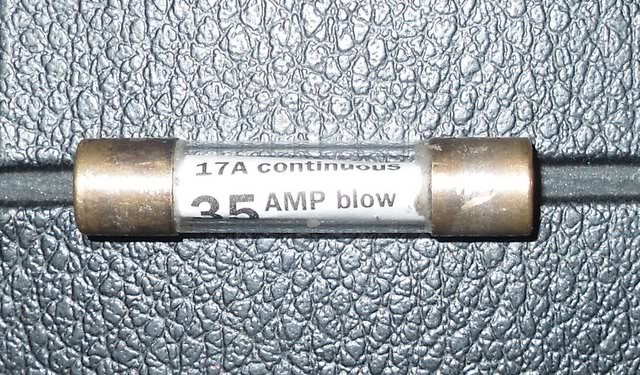
- Joined
- Feb 7, 2010
- Messages
- 4,193
That's the first time I've ever seen a glass tube fuse with a printed label on the inside. I have 5 or 6 tins of glass tube fuses in various ratings, some pretty old.
I could see where an e-start machine might require a 35-amp fuse. I think the main fuse on my ZX-14 is a 35.
I could see where an e-start machine might require a 35-amp fuse. I think the main fuse on my ZX-14 is a 35.
- Joined
- Nov 20, 2004
- Messages
- 21,112
Danno said:I could see where an e-start machine might require a 35-amp fuse. I think the main fuse on my ZX-14 is a 35.
Why? The starter current (100A+) doesn't pass through the fuse and the rest of the electrical loads are much the same as earlier models.
+1See it a lot. Weak spring/corrosion = high resistance melted, not over current. Replace the holder, carry on. :mrgreen:
Definitely the problem. Poor/dirty connection = high resistance=heat generation=melting holder.
- Joined
- Feb 7, 2010
- Messages
- 4,193
L.A.B. said:Danno said:I could see where an e-start machine might require a 35-amp fuse. I think the main fuse on my ZX-14 is a 35.
Why? The starter current (100A+) doesn't pass through the fuse and the rest of the electrical loads are much the same as earlier models.
Then I wonder why Podtronics advises use of a heavier-duty regulator with the Mk III alternator and electrical system? Doesn't the E-start alternator have a higher output than non-E-start older models? it's a different part # and more expensive, so it must be different somehow.
Personally, a 20 amp has always been enough in one of these old nails.
- Joined
- Nov 20, 2004
- Messages
- 21,112
Danno said:L.A.B. said:Danno said:I could see where an e-start machine might require a 35-amp fuse. I think the main fuse on my ZX-14 is a 35.
Why? The starter current (100A+) doesn't pass through the fuse and the rest of the electrical loads are much the same as earlier models.
Then I wonder why Podtronics advises use of a heavier-duty regulator with the Mk III alternator and electrical system?
Doesn't the E-start alternator have a higher output than non-E-start older models?
it's a different part # and more expensive, so it must be different somehow.
You appear to be confusing (sorry) alternator output with fuse rating. The 850 Mk3 does have a higher output alternator (with or without a Pod. reg/rec) but it has the same 35A (blow) fuse recommendation as earlier Commandos.
Danno said:Personally, a 20 amp has always been enough in one of these old nails.
A 20A continuous fuse will be. 20A blow (10A continuous) would be borderline.

- Joined
- Apr 7, 2010
- Messages
- 45
In the US I have never seen blow fuses. The 35 amp fuse if a regular (modern) type is way too much. I have never had a problem with modern 20 amp fuses, remember you want the fuse to blow if you have a problem, as opposed to wiring etc. melting.

- Joined
- Jun 1, 2011
- Messages
- 555
I had to go out in the cold and look. I have never heard of the blow fuse. Mine has a 30 AMP US and has had one in the last 5 years I have ridden it. (I always carry an extra just in case)
The manual says 35 AMP.
In US terms and availability what is the proper fitment?
Mine is a 71 750
The manual says 35 AMP.
In US terms and availability what is the proper fitment?
Mine is a 71 750

Deets55
VIP MEMBER
- Joined
- Oct 3, 2013
- Messages
- 1,649
It has always been my understanding that wire size dictates fuse size. The fuse is only there to protect the wire. When a circuit is designed, load is calculated, which determines the wire size, then the fuse matches the wire. Case in point, your (USA) house may have 220 volt and 200 amp service. The main breakers protect the panel box, each sub circuit has a calculated load with wires to match and then a breaker to protect the wire. i.e. 15 amp circuit gets a 14 gauge wire, etc.
Slow and fast blow fuses have been around for as long as I remember, not so much in the auto field but I use to see them all the time in electronic hobbie shops. They were even available for home use prior to circuit breakers in the good old days of screw in fuses.
I am guessing Norton (and probably other companies) went with the slow blow fuse to compensate for surges. With only one main fuse it probably would not take much to pop a fuse when riding with lights on and then hitting the brake and horn at the same time, or something similar.
Pete
Slow and fast blow fuses have been around for as long as I remember, not so much in the auto field but I use to see them all the time in electronic hobbie shops. They were even available for home use prior to circuit breakers in the good old days of screw in fuses.
I am guessing Norton (and probably other companies) went with the slow blow fuse to compensate for surges. With only one main fuse it probably would not take much to pop a fuse when riding with lights on and then hitting the brake and horn at the same time, or something similar.
Pete
- Joined
- Oct 28, 2009
- Messages
- 1,464

Not mentioned so far is that fuse holders also have an amperage rating. There are a lot of junky light plastic fuse holders that are not be adequate for a 25 or 35 amp fuse. A higher amp fuse holder will have heavier wire, better connections, and a higher temperature plastic such as bakelite. Here is one example: http://www.wiringproducts.com/inline-he ... 10-ga.html
This could be an explanation as to why the holder melted but the fuse did not blow. Just a thought.
Stephen Hill
This could be an explanation as to why the holder melted but the fuse did not blow. Just a thought.
Stephen Hill


- Joined
- Nov 20, 2004
- Messages
- 21,112
MikeM said:The manual says 35 AMP.
Yes, 35A blow so 17A continuous.
MikeM said:In US terms and availability what is the proper fitment?
Mine is a 71 750
35A blow = 17A continuous are available from British bike parts/electrical suppliers in the US, ........
http://www.britishwiring.com/35-Amp-Gla ... p/c135.htm
35 Amp Glass Fuse. (British Rating)
........however, as they are unlikely to be available from local auto parts stores the nearest equivalent to 17A continuous will be either 15A or 20A. The important thing is NOT to use a 35A continuous fuse.
- Status
- Not open for further replies.
Similar threads
- Replies
- 12
- Views
- 1,640
