I remember sanding my F/G tank and the odor it put out. Only way I can describe it is the old Japanese dolls that were made of a real thin formed plastic, and always had that smell to them. Not sure what it was, but it was very distinctive.
Now that is funny, Im pretty sure the one I have was imported from the states and I bought it on our version of ebay with the intention of cutting it up to make a long range roadster. My one was also painted yellow over the blue, then a burnt red, then silver and finally black. Ill try and get some pictures up of it although colours over the net are a bit like Chinese whispers...
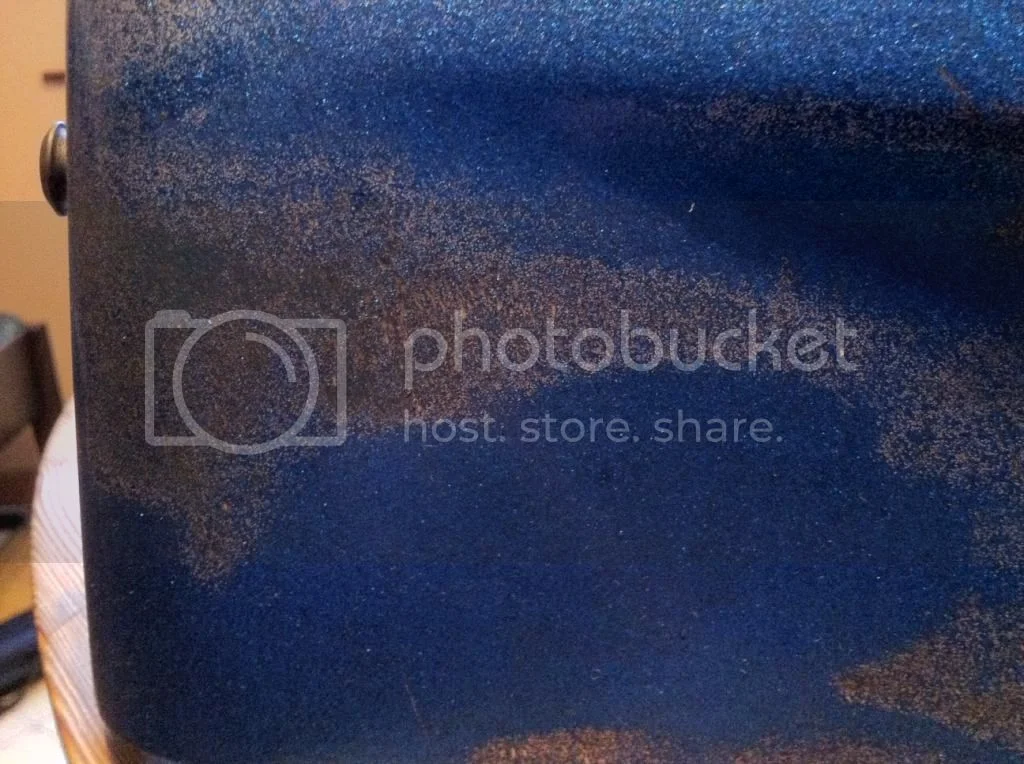
It is also hard to tell if the flakes are blue or silver, Im guessing blue but as soon as you sand into them they look silver.
The flakes are blue-dyed aluminium flake, so when sanded they do turn silver - when the clearcoat wears through it doesn't half look horrible!
After lots of dialogues with various folks, it would appear that the first bikes were done with silver flakes in the gelcoat, and the red bilkes had a candy coat on top.
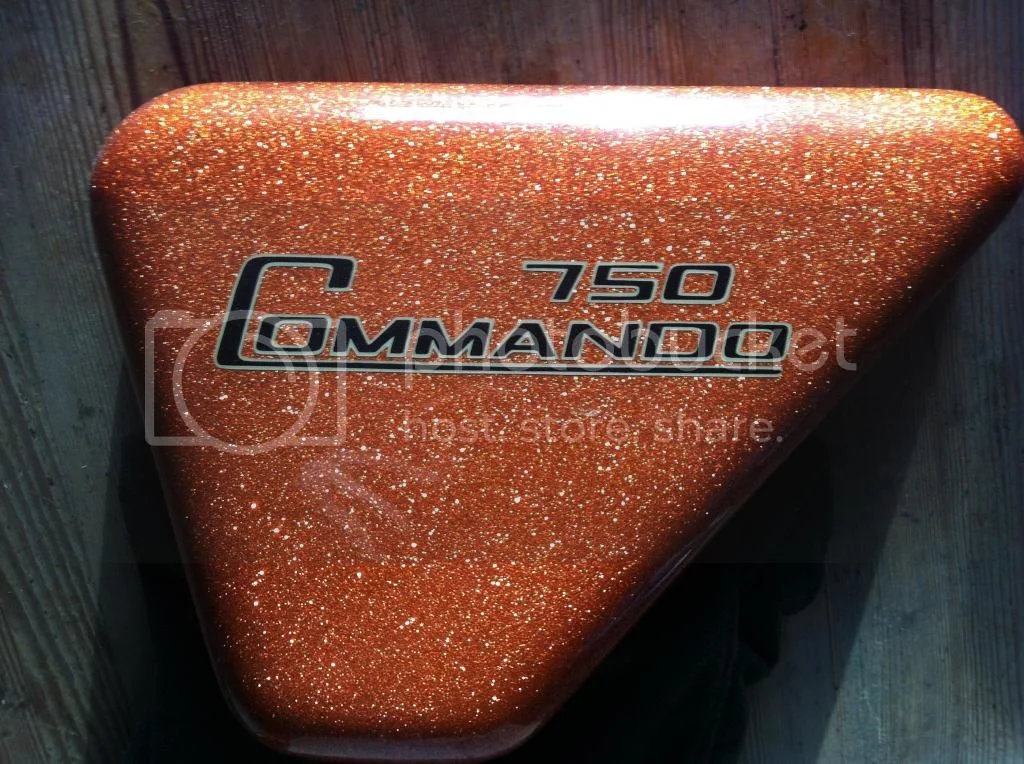
The later (fireflake blue, purple, etc.) flakes are finer, and the flake itself is coloured - House of Kolor flakes are the closest, but some are better matches than others - my 'bronze' bike is looking a bit more 'orange' than the original, but I'll live with it.
After lots of dialogues with various folks, it would appear that the first bikes were done with silver flakes in the gelcoat, and the red bilkes had a candy coat on top.
I can vouch for that with an eyewitness account -
There's a '68 in my area with a two-tone paint job - silver sides and a silver block around the N-V badge around the tail section with the rest in Candy Red. The edge between the colors is a fine black pin stripe. Was probably a stunning bike when the paint was fresh.
Tank is leaking now from E10 gas, so paint job will be lost.
What example of two colors of blue for 1971 do we have?
Andy, regarding the metal chips from my 1974. If you put some paint remover on that paint chip, the chips come out of it silver. I therefore assumed they had blue candy over them.
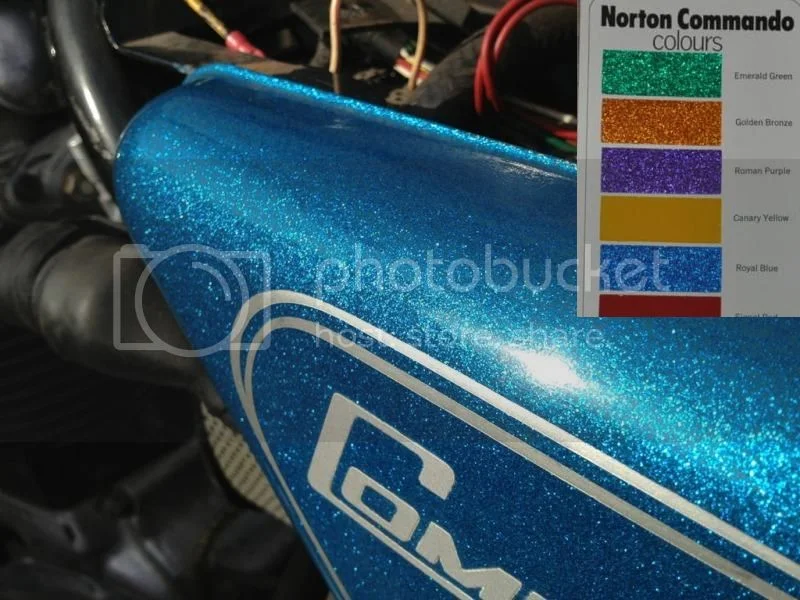
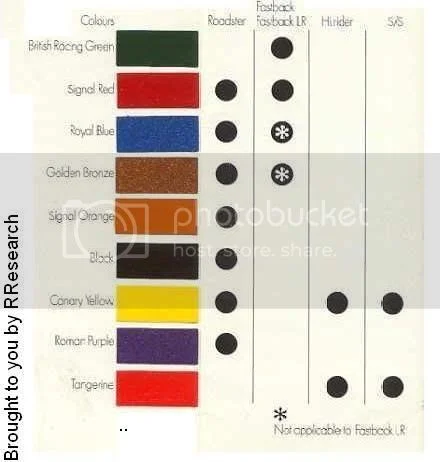
Going back just 2 posts here, I posted an earlier discovered 1971 Norton Color Selector card. Like below.
If you can say this is the same shade of fireflake royal blue ?
Note the different way the card is printed, compared to the one that LAB pointed out.
Both for 1971, it must be added....
Oddly, this looks more like the darker ? shade of fireflake blue, like on some 850s.
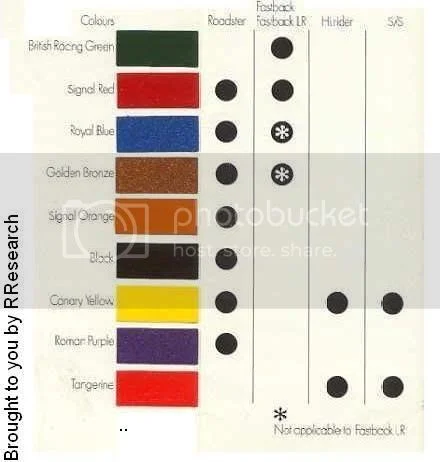
Do you really think that a 40+ year old printed color chart has not changed? Or that it precisely matched what the actual paint color was even when it was new? Printed colors are ink and made from totally different types of pigments. The best you can hope for is somewhat close match to what the original was.
I went through this with my '59 Bonneville. If you look at an original brochure it appears to be Chinese Red and off-white. The actual color is a pale gray. To match the color I was able to borrow an original tank and removed the tank badge. We cleaned and buffed this area and took it to the paint jobber who used the spectrometer to match the colors. The point is even an original paint tank will have faded in the sunlight.
I've got a question about what was wrote earlier
" All '71-on oil tank covers (Roadster/Interstate/Hi-Rider) are basically interchangeable so, yes, it could be either a 2 or 2A Roadster side cover, however the 850 Mk.1A & 2A model L/H (battery) covers do not interchange with Mk.1 & 2, and the Mk.3 L/H covers are different again."
How do I tell if my 1974 850 commando is a MK1 or 2 or 1a or 2a or M3 ??? I talked to a guy that has a steel tank and side covers off a 72 dunstall 810 commando but the tank looks just like mine. I want to buy a set to paint blue but not sure after reading all this if they will be the same as what I have.
Any help?
I've got a question about what was wrote earlier
" All '71-on oil tank covers (Roadster/Interstate/Hi-Rider) are basically interchangeable so, yes, it could be either a 2 or 2A Roadster side cover, however the 850 Mk.1A & 2A model L/H (battery) covers do not interchange with Mk.1 & 2, and the Mk.3 L/H covers are different again."
How do I tell if my 1974 850 commando is a MK1 or 2 or 1a or 2a or M3 ???
Mk2 & 2A from 307311, so a 1974 should be a Mk2 or 2A.
Mk3, 1975, has electric start and rear disc brake introduced early 1975 (from engine number 325001) so it's unlikely to be a Mk3.
As it is a 1974 US model, then it's more likely to be a Mk2 than a 2A. One easy way to tell is to look at the battery tray. If the battery fits in the tray line with the frame then it is a Mk1 or Mk2, if the battery fits across the frame then it is an "A" (or Mk3).
Mk 1 & 2 L/H side covers are secured to the frame by a bracket and Dzus fastener at the forward end, with retaining pins at the rear.
Mk1A & 2A L/H side covers are secured to the battery tray by a Dzus fastener in a recess at the lower rear of the cover, and a single upper retaining pin.
The Access Norton Website uses cookies to keep you logged in if you register.
By continuing to use www.accessnorton.com, you are consenting to our use of cookies.