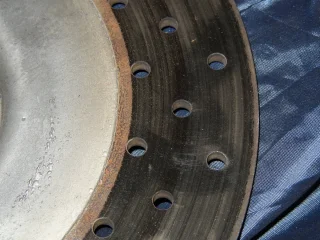
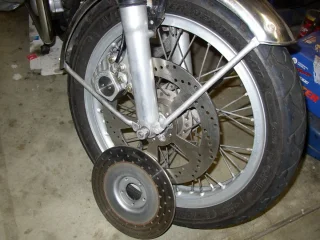
Drilled disc

Status
Not open for further replies.
Gripper wrote: "From my experience of machining cast iron, it forms very fine chipping and the free carbon present manifests itself as black dust, you would get dirty hands handling it and in thin sections such as brake discs it would be very brittle. Whilst I don't intend putting a grinding wheel against my disc, the sparks formed from cast iron would be dull red. My money is on cast steel, but it would be interesting to see what the swarf looks like when machined, Maybe Gary from DBR would know."

I have drilled these disks, the chips are fine, with lots of gray powder. No need for coolant. Machines like cast iron.

Stephen Hill
 
I have copied the Old Brits design template on three disks. The only difference is that I chose to use a smaller diameter hole for the disk pad contact area. I used the diameter of hole to width of disk thickness as a rule. Chambered both sides slightly to mitigate any stress riser then nickle plated after Blanchard ground contact surfaces. I use a stock re sleeved m/c RGM kit, SS hose and Ferodo Platinum pads. Works for me.
Cheers,
Thomas
 
I do know there are reasons such as rotor cooling and effects due to unsprung weight and also rotational inertia to be considered since motorcycle rotors do have considerable mass. That said, I remember in the bicycling world of amateur racing there was a fad in the '70's and '80's of saving as much weight as possible by drilling out every single component. Everything was drilled to a final fragility. So a 20 pound overweight out of shape bicyclist saved 10 ounces. We called the resulting wonder metal "drillium". Pictures of this stuff are a true testimony to the industry and dilligence of some people.

Oh, don't think it hasn't been done to Commando parts. Some with a drill, some with a .308 I think!
 
There are many drilled Norton discs out there that haven't been a problem. As L.A.B. linked, I did crack one but only after a couple of hard riding heat cycles with a new set of aggressive pads. There was no "explosion" just multiple hairline cracks that were nearly invisible. Expand the photo to see the cracks. The disc was drilled with three rings of smallish holes and the cracks emanated radially from nearly every one of the middle ring of holes.

I happened into an Alton big disc kit and haven't looked back.
 

Attachments

  • Drilled disc
    3-18-11 013.webp
    291.4 KB · Views: 337
  • Drilled disc
    3-18-11 022.webp
    159.3 KB · Views: 312
I forgot to mention, I use 4 inline smaller holes instead of the 3 inline that OB designed on the disk contact area. I have not seen any hairline cracks yet. I keep and eye on this when ever I change out my AM26 avons.
Cheers,
Thomas
 
Thomas, Gary Holowich wants to sell out and retire since he's 70+ Looks like you would be the guy to take up his slack.
 
I have seen a couple of hairline cracked drilled discs, so not that common. Even my own drilled disc, (not centre area) has lasted well with standard set up, but a system that can put more energy onto the disc, who knows. With cast iron, you could be one drilling from failure as the stress changes in the material. Ask a brake disc manufacturer to make you a single piece dished brake disc 1/4 thick and you will get a common reply.
 
Status
Not open for further replies.
Back
Top