Cylinder Hone

Status
Not open for further replies.
Joined
Oct 28, 2009
Messages
1,465
Country flag
A neighbour offered me a four stone hone similar to this:
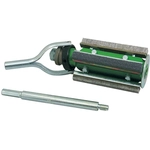
He used it to go up a size on an outboard engine after the engine seized. The original bore was scored and tapered beyond tolerances.

I believe "back in the day" mechanics would use hones made by Sunnen and Lisle, on a drill, to clean up a bore and go up a bore size.
Could this be done on a cast iron Norton cylinder that needs a rebore?

Sure, I am aware that most folks use their local machine shop, or ship the cylinder to J.C.
And I am aware that some folks use a hone like this to clean up the surface, without altering the size.

But is a two or four stone hone, trued for parallel, used on a drill, a reasonable way to go up a bore size?
It would be useful to hear from anybody who has actually used one.
 
The issue with honing is it lacks rigidity and where it removes material the most the stones also wear the most, so when asked to cut material from a misshaped bore you end up with a larger misshaped bore.
 
htown 16 wrote: "Use a ball hone. It removes minimal material."
Yes, I agree that for deglazing purposes, that is the way to go.
I was wondering more specifically how well a two or four stone hone can straighten a bore, or take it up a size.
I take kommando's point that the stones might start parallel, but then wear so they won't be.
The Sunnen kit includes a truing ring, which I assume means that part of the process is truing the stones.
 
When using a precision grinder to grind a journal you at first take large cuts, the wheel wears and you can see marks on the journal. Then as you approach the final size you dress the wheel with a diamond cutter to true the wheel and put a flat surface before taking the final cut and the marks disappear. So if you could dress the stones flat during the series of cuts that just leaves the lack of rigidity which means you can't control the centre of the bore location and it being vertical.
 
I fitted new pistons and rings to this rebuild. I bought a cheap hone from a supplier and gave it second thoughts about using it to deglaze, for the previously mentioned reason. The bores had weared evenly other than one vertical skid mark. I took it to a machine shop and for a reasonable cost was done on the machine. Honing is a certain skill which takes a certain touch and I believe it is a procedure to be left to an expert with the proper equipment. These Nortons are forgiving and tolerant in many ways, but cylinders are scarce so keep the material removal minimal.
 
If your bores are worn then get over sized pistons and take it to a machine shop for the rebore as they will bore to size and hone to ring clearence as well most worn bores are oval shaped from the way the power is taken from the pistons thrushing forward, a boring machine has cutter tools and the hones are used to clean up the bores after the boring has been done and to get the right clearence without taking to much off and deglaze for rings to bed in, as well the machine shop will have all the gauges for messurements.
 
You cannot hone to the next bore size as the OP mentioned above. The hone is for finishing ONLY. Or, a means to break glaze & re-establish the proper cross-hatch for ring seating.
Pay a reputable engine rebuild machine shop to do this kind of work.
 
Hi Stephen, I remember my big brother using a similar hone on a worn out old Honda 100 back in the early 70's. We didn't have a bunch of money and he was able to get the new piston and rings to "fit" and it worked and we rode the wheels off that darned bike. I think "shade tree" mechanics from "back in the day" might have done similar things to what you're talking about by using the hone that way. But its not a good idea. Komando is right I believe, it just becomes more misshapen. Ours were low tech air cooled little engines that we got going again, I would want to get my barrel trued and bored straight if it needed to go up a size.
 
Not with a drill. Cleaning up the walls is one thing, and tricky, but resizing...no.
You cant achieve an accurate bore by hand, too many variables in place.
You will end up taking it apart again and then to a shop that has the right tools to do it properly.
 
Not with a drill. Cleaning up the walls is one thing, and tricky, but resizing...no.
You cant achieve an accurate bore by hand, too many variables in place.
You will end up taking it apart again and then to a shop that has the right tools to do it properly.
Agreed with the above, you can't use any old high speed drill, you need to use a slow speed one like a screwdriver speed.
 
Nothing wrong with hone your own engine, as long as you relpace/ dress your stones regularly and have access to a bore measuring clock gauges which you check regularly to maintain parallel bores.
I don't have the last bits, but my stones on mine are replaced frequently.
 
I use exactly such a Sunnen/Lisle mobile Type hone besides a universal van Norman type boring bar.
Yes you can use it, and yes one can work to tight toleramce given proper attention, procedure etc given, in case order yourself the Sunnen bible.
Imho a lot of stories are at vwry best urban myth B.S., given you use proper as before mentioned means and good measuring tools.
On my last two cylinders i had bout 7/1000-1/100mm run-out

Kind regards

Christian
 
Last edited:
Nothing wrong with hone your own engine, as long as you replace/ dress your stones regularly and have access to a bore measuring clock gauges which you check regularly to maintain parallel bores.
I don't have the last bits, but my stones on mine are replaced frequently.

I ran the ball hone through my stock bore cylinder which measured up fine prior to. (Same done on the lifter/follower bores)
#
I would think the lubricant (and grit number) (or whatever you want to call them) used would have some importance to avoid excessive abrasive loss to the cross hatch from tool wear.
To thin and the hone will wear.

I would be surprised if anyone is getting a cylinder rigid bored oversize commercially then honing the last few 0.0001" at home in the garage with a eBay bought hone.
#

I probably said this before.
Maybe the late 1970's and I go around to a mate's (very good with electronics) and the Mk1 Cortina engine block with one piston sticking out of one bore is on the lawn.
He is putting new (standard) rings in and that piston is one sourced from the wreckers which is stuck which I tapped out with a piece of wood.
Scraping the top I show him it is oversize and will not work in that standard bore being to big at the skirt (etc)

I watched him emery (There might have been filing involved but forget) the piston until it fit the bore and it was duly fit with the new standard ring set along with the three other pistons.
It ran fine oddly enough.

The same mate inherited the family AP6 Valiant which was a little smoky, he came round to show me the new 'dual exhaust one day, one being a little smoky oddly enough.
All oddity was removed when it was revealed to be some form of corrugated hose (like on a vacuum cleaner) that went the length of the car to the rocker cover.

His classic mod was turning up in that column shift Cortina with a modified record turn table on the drive shaft tunnel (at a stop use at the beach) homemade (poorly) box speakers in place of the back seat 40 years before it was deemed normal.
A trend setter but somewhat dodgy mechanic.

I guess you can overthink things mechanically on occasion.
 
His classic mod was turning up in that column shift Cortina with a modified record turn table on the drive shaft tunnel (at a stop use at the beach) homemade (poorly) box speakers in place of the back seat 40 years before it was deemed normal.
In my neighborhood, that's called going "ghetto".
 
I ran the ball hone through my stock bore cylinder which measured up fine prior to. (Same done on the lifter/follower bores)
#
I would think the lubricant (and grit number) (or whatever you want to call them) used would have some importance to avoid excessive abrasive loss to the cross hatch from tool wear.
To thin and the hone will wear.

I would be surprised if anyone is getting a cylinder rigid bored oversize commercially then honing the last few 0.0001" at home in the garage with a eBay bought hone.
#

I probably said this before.
Maybe the late 1970's and I go around to a mate's (very good with electronics) and the Mk1 Cortina engine block with one piston sticking out of one bore is on the lawn.
He is putting new (standard) rings in and that piston is one sourced from the wreckers which is stuck which I tapped out with a piece of wood.
Scraping the top I show him it is oversize and will not work in that standard bore being to big at the skirt (etc)

I watched him emery (There might have been filing involved but forget) the piston until it fit the bore and it was duly fit with the new standard ring set along with the three other pistons.
It ran fine oddly enough.

The same mate inherited the family AP6 Valiant which was a little smoky, he came round to show me the new 'dual exhaust one day, one being a little smoky oddly enough.
All oddity was removed when it was revealed to be some form of corrugated hose (like on a vacuum cleaner) that went the length of the car to the rocker cover.

His classic mod was turning up in that column shift Cortina with a modified record turn table on the drive shaft tunnel (at a stop use at the beach) homemade (poorly) box speakers in place of the back seat 40 years before it was deemed normal.
A trend setter but somewhat dodgy mechanic.

I guess you can overthink things mechanically on occasion.
That it RAN was adequate by young guys with no money. How long it would last is not proven. Also, I call BS on an oversized piston being hand cuffed down to standard bore. How did he deepen the ring grooves to accept the standard rings?
 
That it RAN was adequate by young guys with no money. How long it would last is not proven. Also, I call BS on an oversized piston being hand cuffed down to standard bore. How did he deepen the ring grooves to accept the standard rings?

I could care less if you doubt it, I saw it with my own eyes. (Do I recall the specifics of the rings, no) and the car on the road for many years afterward.
 
Coarse sandpaper drawn slowly over the bores at an angle works well. Just wash well afterwards. Not saying this is a recommended honing technique, I just couldn't think of a reason not to and it worked.
 
Status
Not open for further replies.
Back
Top