
Thanks for visiting Access Norton
- Guest view limit reached
- Create a free account (more details)
- Already a member? Click here to login
You are using an out of date browser. It may not display this or other websites correctly.
You should upgrade or use an alternative browser.
You should upgrade or use an alternative browser.
crankshaft bob weight
- Thread starter jseng1
- Start date


jseng1
Basic
- Joined
- Nov 26, 2009
- Messages
- 3,457

Mentioning the balance factor is fine - but I want to see the bob weight - not just the balance factor. I want the bob weights of stock Commando cranks. We already know what the balance factor is for those. And I don't want it from a manual. I want the actual measured bob weighs to verify these balance factors.The bob weight has to be for a balance factor - i.e. a percentage of the partial mass of the conrod
Last edited:
jseng1
Basic
- Joined
- Nov 26, 2009
- Messages
- 3,457
I just talked to Revco balancing and they've measured them at 52% and found (from customer feedback) that they run smoother at cruzing speed at 65% He said these were dry factors but they don't match (wet & dry) with what Carl H quoted above.
Last edited:


hybridracer
Basic
- Joined
- Feb 21, 2013
- Messages
- 363

And importantly, cruise at what engine RPM?

Fast Eddie
VIP MEMBER
- Joined
- Oct 4, 2013
- Messages
- 23,055
Here is Cycle World's recent video on Balance Kevin C and Mark H who raced and owns Commandos.
Sadly that’s an hour and ten mins long, so will have to wait!
But I can tell you with Dyno backed certainty that (excessive) vibration definitely consumes power.
My balancer says his balancer spins up freely and quicker when he does things to make the crank better. He/we also discovered a few things that surprised me with stock cranks.
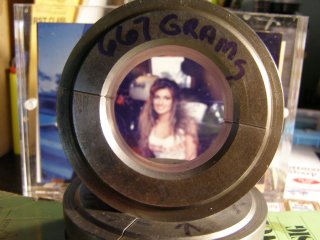
This is pair of test wts I had made, the Hooters girl also has a nice balanced pair, too
Isn't that what the shop manual tells you with "23.55oz. (667.6 grams) on each journal" For a factory balance job?Mentioning the balance factor is fine - but I want to see the bob weight - not just the balance factor. I want the bob weights of stock Commando cranks. We already know what the balance factor is for those. And I don't want it from a manual. I want the actual measured bob weighs to verify these balance factors.
This is pair of test wts I had made, the Hooters girl also has a nice balanced pair, too
Attachments
jseng1
Basic
- Joined
- Nov 26, 2009
- Messages
- 3,457
I'm measuring 638 grams (not 667) for the 850 at 52% wet. Maybe close enough but looking for an average.My balancer says his balancer spins up freely and quicker when he does things to make the crank better. He/we also discovered a few things that surprised me with stock cranks.
Isn't that what the shop manual tells you with "23.55oz. (667.6 grams) on each journal" For a factory balance job?
This is pair of test wts I had made, the Hooters girl also has a nice balanced pair, too
Balance (wet) Norton 850 stock
piston 317
rings 20
pin 72
rod PE 77
reciprocating one side 486
reciprocating total 972
big end w bolts 318
big end shells 43
crank oil for one side only 25
big end one side 386
big end total 772
reciprocating x 52% 505.44
Plus rotating = bob wt 1277.44
The next big question is - you're not going to have oil in the crank when you attach your bob weight to balance it - so you have to use dry weight instead of wet weight correct? This gets confusing.
Last edited:

acotrel
Flagged
- Joined
- Jun 30, 2012
- Messages
- 15,014

I have always thought the balance factor of the Commando crank was 52% dry. Raising it increases the revs at which the motor runs smooth and accelerates faster. The way I raised the balance factor was by screwing a steel plug into the hole in the counterweight. which had been drilled to lower the balance factor. It is probably a recipe for disaster. I once had a Triumph crank which had weight added to the bob weights by arc welding. It looked horrible, but the motor was extremely fast. I sold it to get my 500cc short stroke Triton. I was an idiot. The Commando with Isolastics and low balance factor solves the vibration problem. But even when on public roads, I never ride a motorcycle slowly. That is the reason I do not usually ride on public rods. The low balance factor in the Commando motor has to lower performance. It might not vibrate, but the energy due to the imbalance at high revs has to go somewhere, if it does not go down the chain.

hhh
Basic
- Joined
- Jan 7, 2023
- Messages
- 251

No, no, no, no, no. There is no "imbalance at high revs," again: it's balanced by the entire drive assembly acting partially in place of a crank counterweight by its freedom to move within the main frame. This is not rocket science. It's obvious. There is no "lower performance," and there would be no gains by increasing the balance factor IN A COMMANDO ISOLASTIC FRAME. Vibration energy does not go down a chain, and in a Commando frame, the chain is going up and down with the engine and is part of the effective crank counterweight to a small degree.The low balance factor in the Commando motor has to lower performance. It might not vibrate, but the energy due to the imbalance at high revs has to go somewhere, if it does not go down the chain.

slimslowslider
VIP MEMBER
- Joined
- Jun 29, 2010
- Messages
- 329

Long time ago, I did this theoretical/practicle excersize on a 850 Mk2 crank:
I had to install +20 Emgo pistons in a 850 Mk2. I found out they were slightly heavier than the standard AE's (originals).
I wondered what this would mean to the balance factor. A friend of mine has a nice balancing jig, so I gave it a go.
Did some calcs first, had not done that before, and I really wonder if they make sense.
Can someone check them for me? Especially this compensating for oil I did.
The jig looks like in the pictures below. Thanks a lot, Bennie.
Balancing a 1974 850 Mk2 crankshaft with +20 EMGO pistons
Recip weight (Mrecip)
- piston, incl...
I wondered what this would mean to the balance factor. A friend of mine has a nice balancing jig, so I gave it a go.
Did some calcs first, had not done that before, and I really wonder if they make sense.
Can someone check them for me? Especially this compensating for oil I did.
The jig looks like in the pictures below. Thanks a lot, Bennie.
Balancing a 1974 850 Mk2 crankshaft with +20 EMGO pistons
Recip weight (Mrecip)
- piston, incl...
- slimslowslider
- Replies: 6
- Forum: Norton Commando Forum

Having little balancing experience with a local well know automotive balancer ; D. Dunbar. And asking a few basic questions to get answers from him, I'm more interested in:
What was done to the stock 750 or 850 cranks to re balance an original crank. How much imbalance was there to bring it to stock specs with similar to stock parts weights. And where was weight added or removed.( approximately).
Or what was the factor changed to and where was weight added or taken away from. And how much weight.
And the factor wet or dry and the oil weight added if used.
In other words, How accurate was a factory balance job? and was there any imbalance "side to side" or "rocking coupling" (If that is the proper term.
****Dave Dunbar is a mechanical legend in my area and does the balancing on John Healey's Vincents and other bikes as well as numerous others including exotic vintage car engines.
What was done to the stock 750 or 850 cranks to re balance an original crank. How much imbalance was there to bring it to stock specs with similar to stock parts weights. And where was weight added or removed.( approximately).
Or what was the factor changed to and where was weight added or taken away from. And how much weight.
And the factor wet or dry and the oil weight added if used.
In other words, How accurate was a factory balance job? and was there any imbalance "side to side" or "rocking coupling" (If that is the proper term.
****Dave Dunbar is a mechanical legend in my area and does the balancing on John Healey's Vincents and other bikes as well as numerous others including exotic vintage car engines.
acotrel
Flagged
- Joined
- Jun 30, 2012
- Messages
- 15,014
Why do Commando crankcases break through the main bearing housings when the motor is revved to 8000 RPM ? Triumph 650 motors do not do that. The crank balance factor is set to suit the revs. Isolastics do not change what the crank does to the crankcases. As the revs rise, the counterweight on the crank is supposed to smooth out the internal forces in the motor. Isolastics are cosmetic. They turn a sporty motorcycle into a sensible ride. So first - decide how you are going to ride the bike. It is not one size fits all. My feeling is that a normal Commando is a good compromise.
I have a set of crankcases in my shed to which I have had a plate welded. A kid used to ride his Commando on the Great Ocean Road on Sundays with his mates, and regularly revved it to 8000 RPM. He gave me most of the motor. If I was going to race a normal Commando, I would raise the balance factor to avoid a blow-up.
I have a set of crankcases in my shed to which I have had a plate welded. A kid used to ride his Commando on the Great Ocean Road on Sundays with his mates, and regularly revved it to 8000 RPM. He gave me most of the motor. If I was going to race a normal Commando, I would raise the balance factor to avoid a blow-up.
acotrel
Flagged
- Joined
- Jun 30, 2012
- Messages
- 15,014
With my 850 motor, the balance factor is 72%. It is dead smooth at 7300RPM. I have never tempted fate by revving it higher, and it does not need to go higher - it is fast enough - and that surprises me. It is the most responsive motorcycle I have ever ridden. Using the torque is tricky. It was hopeless with normal ratio gears, and jetting is critical.
I think guys who speculate when they race, probably do better. I would never buy a 6 speed close box on spec. - but some guys would. If I'd had the TTI box the last time I raced, I would have scared the shit out of 20 guys. I don't think I will ever get to use it.
I think guys who speculate when they race, probably do better. I would never buy a 6 speed close box on spec. - but some guys would. If I'd had the TTI box the last time I raced, I would have scared the shit out of 20 guys. I don't think I will ever get to use it.

concours
VIP MEMBER
- Joined
- Dec 29, 2011
- Messages
- 10,596
Disc brake? Drum?With my 850 motor, the balance factor is 72%. It is dead smooth at 7300RPM. I have never tempted fate by revving it higher, and it does not need to go higher - it is fast enough - and that surprises me. It is the most responsive motorcycle I have ever ridden. Using the torque is tricky. It was hopeless with normal ratio gears, and jetting is critical.
I think guys who speculate when they race, probably do better. I would never buy a 6 speed close box on spec. - but some guys would. If I'd had the TTI box the last time I raced, I would have scared the shit out of 20 guys. I don't think I will ever get to use it.
Similar threads


- Replies
- 6
- Views
- 877

- Replies
- 9
- Views
- 1,557

- Replies
- 9
- Views
- 1,479