Crankshaft balance

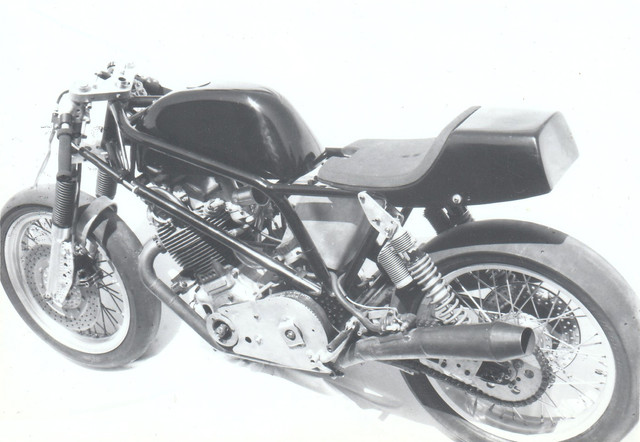
When I built mine it was a 750 commando engine with power max 10.25-1 pistons, triple S cam with a Mick hemmings head and a severely lightened/polished crank
It was balanced to 72% with the motor leaning forward in a wide line frame
The vibration was appalling,I had to wire everything up
It'd shake the float bowls off and the rocker spindle plate bolts etc just for fun
It split the petrol tank and the lugs broke off the battery box
You could barely keep your feet on the pegs
But I think I made a mistake making the engine plates from stainless steel that I had mirror polished
The bolts would never stay tight
Its not the engine plates. Could be the BF but I doubt it. I tried every balance factor from 48 to 85 and the only thing that smoothed the ride in my early solid frame (later became a monoshock) was the lighter pistons.

Crankshaft balance


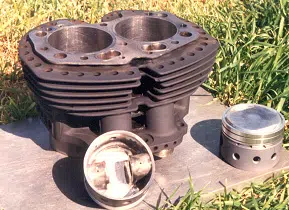
The first lightweight Wiseco pistons with shortened cylinders
Crankshaft balance
 
I have only ever been able to get lighter pistons for one motor. I modified the crowns on two 350cc BSA Gold Star pistons to fit them into a 650 cc Triumph engine. It is a very good thing to do. The crowns formed a squish band.
 
Bad balance may reduce top end RPM & power as mentioned earlier. But the main problem is the Norton rod stroke ratio with is short stock rod and long stroke. It get worse with the 1007cc and its increased stroke. The short stock rod has too much angle at mid stroke and the piston exerts too much side pressure againt the cylinder wall creating too much friction and heat. Triumph and BSA 650 twins have a 2:1 rod/stroke ratio. The Norton has 1.67 a ratio. That ratio is improved to 1.87 with the long rods.
 
Last edited:
One of the things that allows my GM 500cc engine to rev to 13,500 is the "desaxe" arrangement. The cylinder is offset forward of the crank so on the power stroke the angle of the rod is reduced, decreasing side thrust on the piston
 
The crank in my 850 is balanced at 72 %. However once the bike is rolling, the revs never drop below 5,500 RPM. At 7000 RPM it is almost vibrationless. Before it really gets going, it is pretty shocking. I love it - I never believed than anything so bad could be so good. When I was in Melbourne, the bike sat unraced for 25 years, because I believed it was not possible to get sense out of it. I suggest the reason that it does not vibrate is because it has normal 850 pistons - most guys go high compression and use methanol fuel, because of the myths. With either petrol or methanol fuel with standard compression, it is possible to get the bike going just as fast. Jetting and gearing are more important than most of the modifications. Methanol fuel just makes jetting easier.
 
In my lifetime, I have only met two people who really knew how to tune a road-racing motorcycle. Neither of them would ever talk much.
 
One of the things that allows my GM 500cc engine to rev to 13,500 is the "desaxe" arrangement. The cylinder is offset forward of the crank so on the power stroke the angle of the rod is reduced, decreasing side thrust on the piston
When Norton went to the bigger 750 they cheated and shifted the cylinders toward the rear - the opposite of the "deaxe" method and it makes things worse. It creates less than optimal power output, increased noise, and higher running temperatures compared to a more modern, performance-oriented offset. This is worth looking into - maybe mill the case or use a wedged shaped base gasket to correct? Depending on how far you can go without causing other problems.
 
Last edited:
My 920 was dynamically balanced to 62% wet, but it uses isos. The rods are stock, which is probably the lightest you can go. The pistons are those that RGM supplied about 10 years ago when I bought the RGM 920 kit. They weigh almost exactly the same as standard sized original 850 pistons. Roger told me that he selected those particular pistons so that the BF on a stock 850 wouldn't change by using his kit.
As compared to my 850, when above 3000rpm there is no difference, both bikes are smooth as glass, clear mirrors at any speed on the roads, as long as you don't run at real low rpm ( Why would you?)
The spot where everything goes smooth is about 3000 rpm on the 850 and 2800 rpm on the 920. That difference might be in the dynamic balance, or it might be because the 920 has all new isos.
As the original poster mentioned, the dynamic balance seems like money well spent. Only a couple hundred $ to make sure the crank is balanced as well as possible.

Glen
 
When I built my Seeley 850, I thought the motor was crap. However when I filled the hole in the counterweight with a threaded steel plug, the balance factor came out to be 72%. I would have liked a higher factor. However from a slow beginning, I now believe Norton were not stupid when they designed that motor. It is extremely responsive to tuning, but needs the close ratio gearbox. The motor is a different concept to the normal- you are always working with torque rather than top end power. I could not understand the effect of the heavy crank when gearing is low - it must be made to pull. It always seems to spin-up at the same rate regardless of the overall gearing. Close ratios keep it well up in the usable rev range. Wide ratio gears in a road bike keep it sane.
 
So you keep telling us Al but putting a threaded plug in a hole in the counterweight how do you come to the conclusion that it's balanced at 72%, I say you are more guessing than anything as for the gearbox on a Norton, yes first gear is low but that is normal for a road going bike, 2nd and 3rd is great for pick up and 4th is right for cruising the highways and open roads, I run a 19 tooth front sprocket which my Commando came with from the factory (still the same with the Featherbed set up) and I think it's just right for my fun up it the twisties top gear at 4k RPMs is 65 MPH depends on which way the wind blows with my hot motor it will rev freely and can get the ton out of 3rd gear, but these days I have mellowed as the fun police/speed cameras are everywhere, I still race my riding mates when up in the ranges and tight twisties.
My crank was balanced a long time ago back in 82 its pretty smooth for a hard mounted 850 motor as well with everything else done to my motor it's not overly done (built to breath better and get the gases out quick) but good enough for what I use my Norton for, on the road, I can ride around town at 40 MPH in 4th gear any slower and then I drop it down to 3rd, its pretty smooth at that low revs and also very quiet as I run open pipes with very little baffle (cocktail shaker mufflers with mod baffles).
One thing where I did get some vibrations was at the end of my handle bars not all the time mostly at some different parts of the RPM range, but normal handle bars are very thin walled 1.6mm in fact, I fixed this by putting on a set of Renthol alloy bars with 6.5mm thick wall and I no longer get any vibrations through my handlebars and with the solo inner state seat (with the hump) my Norton is a very comfortable all day rider.
So the old gentleman who did my crank balancing in 1982 has got it right, in them days there weren't the lightweight parts that Jim sells to make our bikes smoother but some of the old school builders knew their stuff.
If my Norton wasn't a smooth runner with the hard mount engine I would have sold it a very long time ago but it's a great road going bike with lots of torque, lightweight and great handling of the Featherbed frame.
Would I do it again, sure would.

Ashley
 
On my Metisse 750 I went for a 77% Balance Factor which was a major improvement as I had ridden it at standard 52% for a couple of years in this frame but lost a lot of fillings out of my teeth.
Bike has been on the road in this frame for 26 years now and its great. Have owned it for 39 years as it was originally a 750 Fastback now highly modified after a big smash as Fastback.
Would post a picture but don't know how to.
 
Back
Top