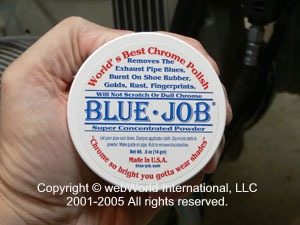
To answer your questions in part:
Chrome forms various oxides at temperature. Each variant of the oxide exhibits a different color, depending on the temperature at which it formed. The color varies from purple to blue to yellow (hottest to cooler).
The thickness is but a few molecular layers; the layer of chrome oxide protects the virgin chrome under from further oxidation.
Removing the blue, and the other colors, removes chrome, and intimately one runs out of chrome. There is a layer of plating under the chrome which will be exposed. This could be nickel, but in cheap chrome jobs is most likely copper.
While the oxide layer is but a few molecular layers deep, cheap chrome jobs have total chrome thickness that is only a matter of a few molecular layers. For example: I was with a woman friend when she bought a chrome faucet fixture for her house. I knew sha liked the design, so I said nothing about the price but I thought "how can you get a quality faucet for $39?" After a year of use in her new home, the faucet developed a stain, which upon close examination revealed to be the copper sub-layer. She never used harsh chemicals on the faucet, but was in the habit of wiping the water stains off with a soft cloth, each time she used the sink. One year of such wiping removed the micron layer of chrome.
Slick