Back to the future P11 shenanigans

Schwany

VIP MEMBER
Joined
Apr 22, 2020
Messages
3,663
Country flag
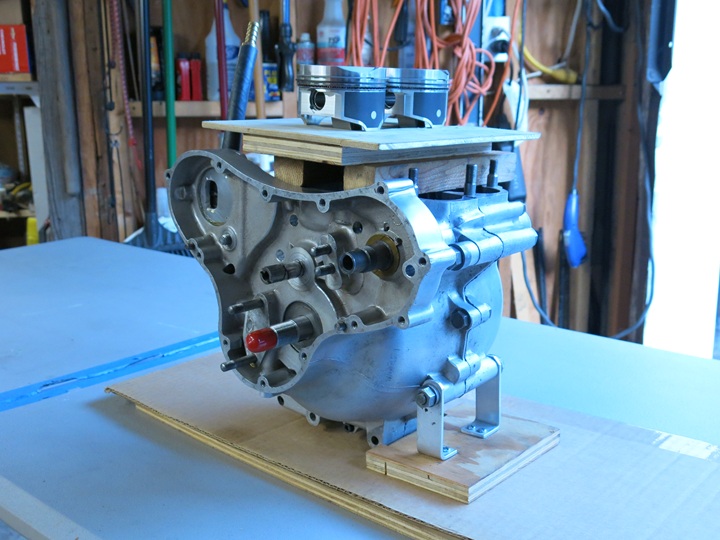
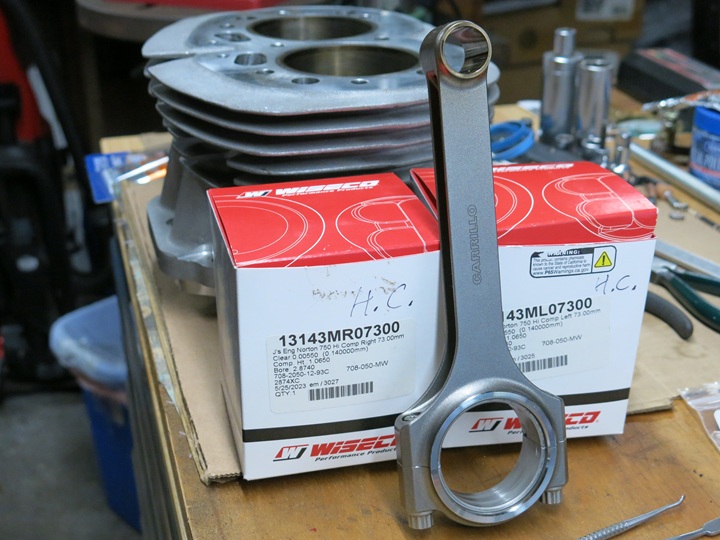
Starting the MAP to JSM long rods and pistons swap in my P11 engine tomorrow. It might take 3 days before I'm ready to stuff the engine back in the frame. I usually run into something that slows me down. For example forgetfulness.

I'll be raising the compression from 8:5:1 to 9:5:1. If nothing else it will sound better. More compression usually also results in a stronger pulling engine if tuned right. Not sure how it would map on a Dyno sheet, but it will feel stronger on the butt dyno. lol

The Molnar crank I am using was balanced for the JSM long rod parts, so it could end up a little smoother running at low RPM than the MAP setup. Of course smoother in a solid mount frame is not like smoother in a Commando frame, but the long rod kits actually do make for a nicer ride as long as one stays in shape for riding a solid mount.

This rebuild will be a slight step backward tech wise with the flat tappets to be used with an SS cam, which I always did like. I'll be advancing it 2 degrees with the stepped JSM cam key. The bronze lifter blocks and Triumph lifters are getting put away.

Not sure why I'm posting about this no big deal thing. I already know it will work fine. I guess I'm trying to get my VIP Membership money's worth.
Back to the future P11 shenanigans


I do have another Carrillo rod. One won't be enough.
 
so what was your final decision on why to remove the bronze blocks?
Installed new sets of blocks for the Triumph lifters in two different sets of barrels. In both cases the Triumph lifters started eating away at the blocks and my oil changes had bronze in them. For the "you don't know how to do it right" crowd. It is very difficult to do it wrong because they are locked in place when the final indexing is done for the blocks. If a person has never done it they won't know what I'm talking about. However I know that won't stop people that have never done it from telling me how it should be done. lol

I wanted to use my SS cam again since it with over 13K miles on it looked better wear wise than the JS2 cam did with about 4.5K miles on it. Plus I don't like the bronze color in my oil. I expect I'll be seeing aluminum in the oil now coming off the inside of the lifter bores of the Molnar barrels. Can't win. :)

I don't really give a rat's rump. I'm fortunate that I can still work on the Norton and there are a few Norton performance parts venders in the USA.

I wouldn't read much into my experience with the bronze blocks. According to Jim it has never happened to anyone else ever. Whatever the case I doubt the 3rd time for me would be a charm. Could also be a cam in my cases is not running 100% perpendicular to the lifters, and the cam lobes put uneven pressure across the little pads turning them against the bronze surface. That won't be an issue with the stock lifters in a round bore. That's my theory anyway.
 
Not everyone automatically assumes "user error"... at least I certainly don't because I've been on the other end of that kind of accusation. In my case, Jim Comstock eventually chimed in on my thread and agreed with me, which made all the finger pointers disappear... all of whom wanted to tell me I fucked up, but None of whom wanted to tell Jim he was wrong.. 🤣

I find it hard to believe that you had the same pronounced lifter block wear twice, and nobody else has ever had that same experience. Maybe the lifter blocks just wear in excessively in the first few rides and other people change their oil without even noticing the bronze sparkles, or they feel like they spent their money and they are going to run what they built until it blows up. 😏 Maybe, after the break in the bronze particulate diminishes and everything is ok. (I actually strain my oil when I change it through a 50 micron filter, then use a magnet to explore the filter for possible chunks)... (paranoia strikes deep...)

I don't see how your lifter blocks could be oriented any different than anyone else's. Over the last 30,000 miles, I've had 1 lifter pad delaminate and had a pair start to make a growl at idle because the faces were starting to wear, so the stock followers are not a fool proof set up either... I think the growling pair was caused by lower oil pressure so I rebuilt the oil pump and so far the growl has not returned...

Keep posting on your rebuild please. Being a mechanically obsessed person, I can never get enough of this kind of stuff.. 😏
 
Installed new sets of blocks for the Triumph lifters in two different sets of barrels. In both cases the Triumph lifters started eating away at the blocks and my oil changes had bronze in them.
I am using BSA lifters in my builds. If the abnormal wear happens to me, rather than removing lifter blocks, I will install iron liners in them. However, with the EF tappets, I doubt there will be a problem.

Do you use stock tappets in your engine? Lash caps or hardened valve stems?

- Knut
 
IMO / FWIW / AFAIK / ETC…

I don’t think you’ll have any issues with the stock tappets destroying your alloy barrels. Hundreds of Maney barrels attest to that.

When you look at the stock tappet in the stock bore, the bearing surface is huge. So long as it gets plenty of clean oil, it should last very well.

HOWEVER… if any crud gets down the tappet bore, it’s got nowhere to go except to grind its way past the lifters!

And the trouble is that pieces of head gasket, carbon off the pistons, etc can very easily fall down there whenever the head is removed.

I’m pretty sure that’s what happened to mine on my 850 as the tappets and bores were pretty FUBAR’d !

So, so long as you avoid that kind of nonsense, I reckon you’ll be jus’ fine.
 
Last edited:
Not everyone automatically assumes "user error"... at least I certainly don't because I've been on the other end of that kind of accusation. In my case, Jim Comstock eventually chimed in on my thread and agreed with me, which made all the finger pointers disappear... all of whom wanted to tell me I fucked up, but None of whom wanted to tell Jim he was wrong.. 🤣

I find it hard to believe that you had the same pronounced lifter block wear twice, and nobody else has ever had that same experience. Maybe the lifter blocks just wear in excessively in the first few rides and other people change their oil without even noticing the bronze sparkles, or they feel like they spent their money and they are going to run what they built until it blows up. 😏 Maybe, after the break in the bronze particulate diminishes and everything is ok. (I actually strain my oil when I change it through a 50 micron filter, then use a magnet to explore the filter for possible chunks)... (paranoia strikes deep...)

I don't see how your lifter blocks could be oriented any different than anyone else's. Over the last 30,000 miles, I've had 1 lifter pad delaminate and had a pair start to make a growl at idle because the faces were starting to wear, so the stock followers are not a fool proof set up either... I think the growling pair was caused by lower oil pressure so I rebuilt the oil pump and so far the growl has not returned...

Keep posting on your rebuild please. Being a mechanically obsessed person, I can never get enough of this kind of stuff.. 😏
Trouble is
People make a judgement without being there in person looking at what went on
 
Could also be a cam in my cases is not running 100% perpendicular to the lifters, and the cam lobes put uneven pressure across the little pads turning them against the bronze surface. That won't be an issue with the stock lifters in a round bore. That's my theory anyway.
Pure eyesight seems to indicate that C/L of followers do not meet C/L of the camshaft. I wish I had a factory cross-section drawing of the engine. Anyone seen this?

Whether flat or radiused followers are used, the point of contact at the follower is always normal to the surface at point of contact (lifting force) and parallel to it (friction force). The lifting force needs to be decomposed into a component parallel to the bore/pushrod, and a component perpendicular to the bore. So, the latter force component and the friction force builds two force couples trying to rotate the follower in the bore (or in the lifter block). This will necessarily cause a substantial area load (more like a line load) because of the tiny area of contact in the JSM design that may squeeze the oil film away. Cam follower judder and bouncing may increase this effect. The uneven wear pattern is less likely with stock followers, because the area of contact is much larger, as FE pointed out.

In the A65, followers run in cast iron bores integral with the barrel. Separate guides of steel are used for the T120 and T140. In both cases, resistance to high area/line load will be much higher than the resistance provided by bronze.

A note aside, in the Velocette Venom/Thruxton, the AMC twins, and maybe some others, camshaft action is transferred via hinged light followers, which allows separation of normal (pushrod) and in-plane forces. There are no force couples and no friction due to oscillating followers. Ramps at the lobes are much easier to handle too. A much better design, IMO.
BMW airheads (/5 series, up) had camshaft followers which resemble those of the Norton. They run central on the camshaft. Followers run in sleeves of hardened steel pressed into the engine cases. They are pressure lubricated.

- Knut
 
Last edited:
IMO / FWIW / AFAIK / ETC…

I don’t think you’ll have any issues with the stock tappets destroying your alloy barrels. Hundreds of Maney barrels attest to that.

When you look at the stock tappet in the stock bore, the bearing surface is huge. So long as it gets plenty of clean oil, it should last very well.

HOWEVER… if any crud gets down the tappet bore, it’s got nowhere to go except to grind its way past the lifters!

And the trouble is that pieces of head gasket, carbon off the pistons, etc can very easily fall down there whenever the head is removed.

I’m pretty sure that’s what happened to mine on my 850 as the tappets and bores were pretty FUBAR’d !

So, so long as you avoid that kind of nonsense, I reckon you’ll be jus’ fine.
I was sort of kidding about the aluminum, but that is good to know it holds up. The stock tappets move pretty nicely inside the bores, so should be as good as it can be.

Fortunately I'm working with really clean parts.
Pure eyesight seems to indicate that C/L of followers do not meet C/L of the camshaft. I wish I had a factory cross-section drawing of the engine. Anyone seen this?

Whether flat or radiused followers are used, the point of contact at the follower is always normal to the surface at point of contact (lifting force) and parallel to it (friction force). The lifting force needs to be decomposed into a component parallel to the bore/pushrod, and a component perpendicular to the bore. So, the latter force component and the friction force builds two force couples trying to rotate the follower in the bore (or in the lifter block). This will necessarily cause a substantial area load (more like a line load) because of the tiny area of contact in the JSM design that may squeeze the oil film away. Cam follower judder and bouncing may increase this effect. The uneven wear pattern is less likely with stock followers, because the are of contact is much larger, as FE pointed out.

- Knut
My eyesight is not pure. Is there a picture here I missed?? :)

That quoted paragraph is in my mind the long version of what I said. I get how things work. I know I sound like an idiot. It's a sand bagging technique. I wouldn't use the flat tappets if I didn't think they would work as I theorized they would. I could still break the engine though. I run it like it was designed in the 21st century. Probably not that wise. I think that has a lot to do with what happens. That and the oil line blowing off.
 
Not everyone automatically assumes "user error"... at least I certainly don't because I've been on the other end of that kind of accusation. In my case, Jim Comstock eventually chimed in on my thread and agreed with me, which made all the finger pointers disappear... all of whom wanted to tell me I fucked up, but None of whom wanted to tell Jim he was wrong.. 🤣

I find it hard to believe that you had the same pronounced lifter block wear twice, and nobody else has ever had that same experience. Maybe the lifter blocks just wear in excessively in the first few rides and other people change their oil without even noticing the bronze sparkles, or they feel like they spent their money and they are going to run what they built until it blows up. 😏 Maybe, after the break in the bronze particulate diminishes and everything is ok. (I actually strain my oil when I change it through a 50 micron filter, then use a magnet to explore the filter for possible chunks)... (paranoia strikes deep...)

I don't see how your lifter blocks could be oriented any different than anyone else's. Over the last 30,000 miles, I've had 1 lifter pad delaminate and had a pair start to make a growl at idle because the faces were starting to wear, so the stock followers are not a fool proof set up either... I think the growling pair was caused by lower oil pressure so I rebuilt the oil pump and so far the growl has not returned...

Keep posting on your rebuild please. Being a mechanically obsessed person, I can never get enough of this kind of stuff.. 😏
Sort of welcome to forum communication 101 in that first paragraph. I've been banned before on a forum where I disagreed with the hive leaders. F- the hive.

I'll post as long as I can keep putting it back together. Today was interesting. I was cussing at myself for forgetting to bring the temporary fasteners over to my assembly table before I applied the case sealer. I also tried a technique to get the crank in the wrong case first. That turned into a wrestling match. I'm losing my touch.
 
My dad was the foreman of a finishing shop for 35 years. After he retired, he would come up to my shop and occasionally help out on the more elaborate finishes. One of the comments he made after he retired was, "When you don't do this stuff every day, you lose your touch" I'm finding that out these days for myself....
 
Minor progress.

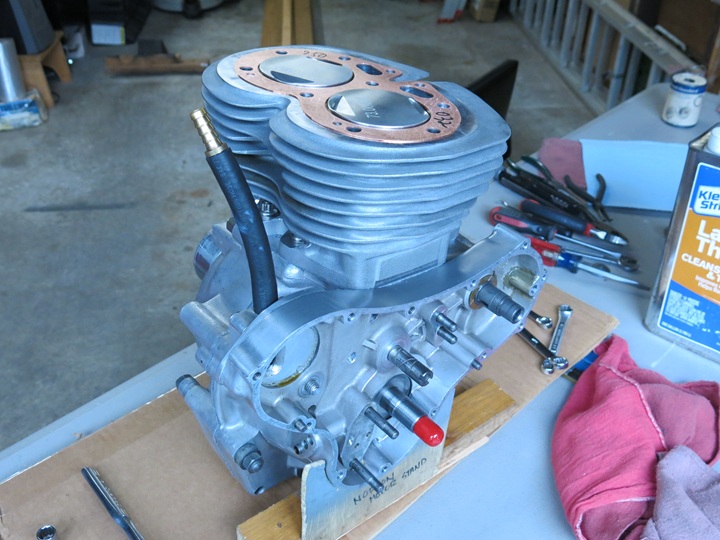
Getting ready to drop on barrels the old fashioned way. I use antique ring compressors. Goop sealant Permatex Optimum Max Torque 27036 is on the bottom of the barrels, none on the cases. I didn't take any pics of the barrel install process, but the barrels dropped right on this time. Hardest part was removing the old ring compressors while holding the barrels up with one hand and pulling the wood piston support away. Lot to be said for alloy 750 barrels being half the weight of stock iron barrels. Old man friendly.

Back to the future P11 shenanigans


Barrels on and the piston clearance measuring begins.

Back to the future P11 shenanigans


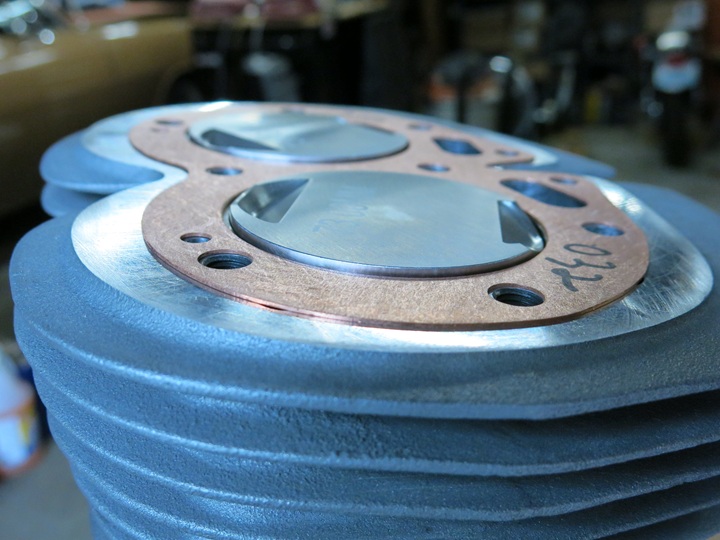
Static measuring I get .047" of clearance with .032" head gasket. My squish band is .117" deep, piston is above gasket .070"ish. Pistons didn't try to lift the head doing a dry head on no bolt up test. Normally I would just bolt it all together at this point, but... I should act like an adult and do a dry bolt up to be sure the pistons clear. Boring....

Back to the future P11 shenanigans


By the way, I did have to elongate 3 holes slightly (the two 5/16" holes at the front and the one 3/8" hole at the back) in the JSM copper head gasket to get clearance around the combustion chamber pockets so the higher compression pistons do not hit the head gasket at the intake side.
 
Lookin’ good.

Those pistons look lovely !
New high comp pistons are always pretty aren't they? They will have a carbon carpet on top soon and be ugly as ever. :)

I pulled a Schwany. Just went ahead and bolted the head down. So far nothing up top is banging on anything else on the bench, but I'm not done getting all the rockers back in. I think my squish might be a lot less than I anticipated using pre bolt down measurements. I'll have some compression. I may need to back off on the ignition timing for pump gas.
 
Don’t forget that a tight squish helps suppress detonation, it can, and often does, mean that there’s less detonation despite the higher CR. You’ve got a stiff crank and very none stretchy rods, you should be cool down to less than 30 thou IMO.

On the topic of the crank, lighter crank and longer rods both change the nature of the engine somewhat, making it more eager to pick up revs quickly. That will suit the 2S cam well IMO.

S’gonna be like a Combat on tren …!
 
It should be fun. Although today's assembly adventure was not. Almost done and a rocker shim slipped through my numb as heck old man fingers on an exhaust rocker. Never had that happen before. It's still down in the pushrod tunnel. Might be caught under the ledge in the Molnar barrels. Only makes some sense if you have the Molnar barrels.

I'm working on coming up with a magnet on a string. So far fishing with it hasn't done the trick. If I can actually get a small enough camera to look down the push rod tunnels I might be able to see what is actually going on down there. Probably be faster to just take the head off though. Unfortunately it is copper coat glued down so I'm not looking forward to the big mess to clean up with extreme care if I pull the head. Maybe I'm aging out. A few fingers of whiskey might be in order. lol
 
I pulled the head and got that skinny rocker washer out of the pushrod tunnel. It wasn't bent.

Copper Spray-a-Gasket is very good head to cylinder sealant with roughed up JSM copper head gaskets. I would use it again for sure. Simple process. I could pick the motor up by the head with all the fasteners out. That is how strong the holding power is. I had to come up with a way to use one of my old pry bars. I had enough scrap wood around to lever the bar off of. 16" pry bar was the solution under the exhaust ports and intake ports. No news there.

By the way, I stuffed a small piece of blue paper shop towel in position to prevent things from going down the pushrod tunnels. Never had to do that before. Turns out the fingers on my left hand can't be trusted. I dropped the same washer again, but this time it rolled down in front of the valve spring pocket like is should if dropped. Probably put the engine in the frame tomorrow and see what else I can screw up and do twice. :rolleyes:

 
Last edited:
I pulled the head and got that skinny rocker washer out of the pushrod tunnel. It wasn't bent.

Copper Spray-a-Gasket is very good head to cylinder sealant with roughed up JSM copper head gaskets. I would use it again for sure. Simple process. I could pick the motor up by the head with all the fasteners out. That is how strong the holding power is. I had to come up with a way to use one of my old pry bars. I had enough scrap wood around to lever the bar off of. 16" pry bar was the solution under the exhaust ports and intake ports. No news there.

By the way, I stuffed a small piece of blue paper shop towel in position to prevent things from going down the pushrod tunnels. Never had to do that before. Turns out the fingers on my left hand can't be trusted. I dropped the same washer again, but this time it rolled down in front of the valve spring pocket like is should if dropped. Probably put the engine in the frame tomorrow and see what else I can screw up and do twice. :rolleyes:

Because of "Butterfingers" syndrome I have resorted to using long locking medical clamps when try to fenagle washers into tight spaces where there is a risk of a bout of Tourette's . It's worked so far.
Back to the future P11 shenanigans
 
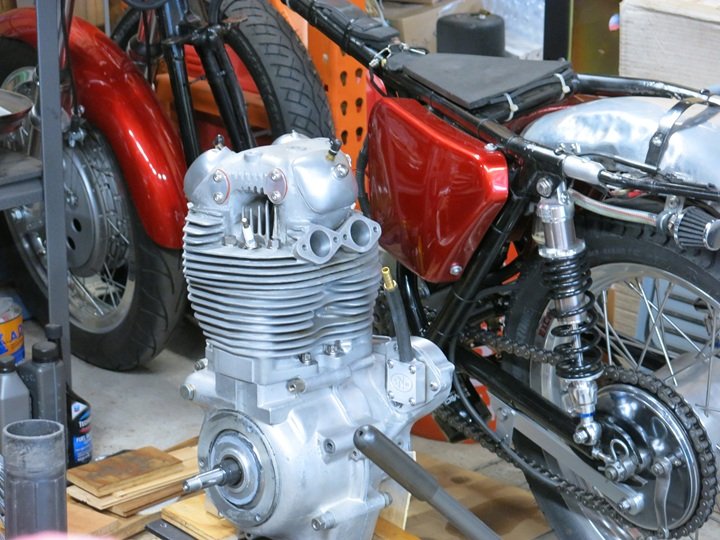
Way behind schedule on this in my head, but should have it started tomorrow. I expect it'll be a bit of a tuning session, but not bad.

Mistakes: Push rods are about .080 too long for perfect geometry, but it'll run alright. Kicking it over without plugs in, carburetors installed or exhaust on is so smooth and easy. Sure wish it was like that when ready to fire up. However, my experience with higher compression and a SS cam is I'll have to lay into it to get it to light up. If I only had one of those magical Joe Hunt magnetos. Not really, too fiddly for me. because I would only install one behind the cylinders and too many chains are involved for my liking.

More later.
 
Back
Top