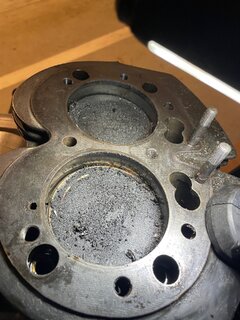
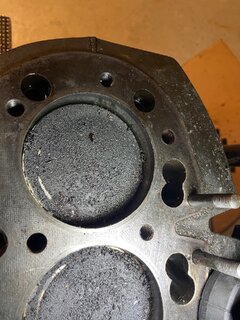
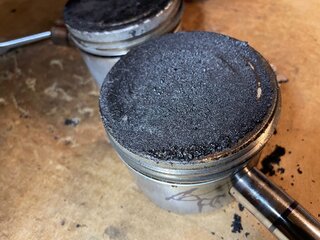
850 Head, cylinders and pistons are out. Can you comment on photos of piston tops and combustion chambers?

DennisMo

VIP MEMBER
Joined
Jun 6, 2023
Messages
412
Country flag
I really appreciate your help as this is first time opening up my 850.
Thanks
Dennis

(Bore measurements will be in next post)
 

Attachments

  • 850 Head, cylinders and pistons are out. Can you comment on photos of piston tops and combustion chambers?
    IMG_8803.JPG
    448.5 KB · Views: 246
  • 850 Head, cylinders and pistons are out. Can you comment on photos of piston tops and combustion chambers?
    IMG_8804.JPG
    931 KB · Views: 220
  • 850 Head, cylinders and pistons are out. Can you comment on photos of piston tops and combustion chambers?
    IMG_8805.JPG
    747.6 KB · Views: 215
  • 850 Head, cylinders and pistons are out. Can you comment on photos of piston tops and combustion chambers?
    IMG_8813.JPG
    982.1 KB · Views: 220
  • 850 Head, cylinders and pistons are out. Can you comment on photos of piston tops and combustion chambers?
    IMG_8814.JPG
    957.9 KB · Views: 254
How many miles? IMG_8814 appears to have wet oil - is that true? The plugs, what little I can see show the mixture about right, so I would say you're burning oil and if that's wet oil in IMG_8814, a lot of oil. My guess would be a bad valve seal on both sides and maybe a slow intake area drain and/or running the bike on the side stand.

With the head level and the chambers up, pour in some gas and see if the valves leak. I'm suspicious of the valve in IMG_8814 that looks rusty under the carbon.
 
Thanks Greg.

As for mileage that is a tough one as the previous owner figured 10,000 miles or so.
I put on perhaps 2000 miles since I bought it. This looks like far more wear.

But I did run the bike in stop and go traffic for two hours plus in high summer heat and oil
pressure went down to 2 psi from its usual 10. I suspect the inlet valve seals got impaired and no longer did their
work. But maybe more damage than that. I don't have the experience to know what the effect of severe over heating is
on an air cooled engine. Ie what gets compromised. Knowing my luck, bore wear is an outcome....
For automotive, one never lets overheating happen...

There is a ridge of carbon oil crud on the outer top diameter of the combustion chamber in IMG_8813.
I have never seen that in automotive.

Rockers and valves come out tomorrow.

Thanks again
Dennis
 
Thanks Greg.

As for mileage that is a tough one as the previous owner figured 10,000 miles or so.
I put on perhaps 2000 miles since I bought it. This looks like far more wear.

But I did run the bike in stop and go traffic for two hours plus in high summer heat and oil
pressure went down to 2 psi from its usual 10. I suspect the inlet valve seals got impaired and no longer did their
work. But maybe more damage than that. I don't have the experience to know what the effect of severe over heating is
on an air cooled engine. Ie what gets compromised. Knowing my luck, bore wear is an outcome....
For automotive, one never lets overheating happen...

There is a ridge of carbon oil crud on the outer top diameter of the combustion chamber in IMG_8813.
I have never seen that in automotive.

Rockers and valves come out tomorrow.

Thanks again
Dennis
Don't pull the rocker shafts out. You can get the valves out without disturbing the rockers. You just need the correct valve spring compressor tool.
Bikes being stood for ages, sometimes years, then getting sold to new owners who then ride them around without doing a full engine recommission/rebuild usually run into problems like this. Cylinder bores/ valves/ seals compromised by corrosion and age hardening. One cylinder is usually worse than the other because the engine when stopped has a valve/s open. A decent photo of the cylinder walls please.
 
Last edited:
Thanks Greg.

As for mileage that is a tough one as the previous owner figured 10,000 miles or so.
I put on perhaps 2000 miles since I bought it. This looks like far more wear.

But I did run the bike in stop and go traffic for two hours plus in high summer heat and oil
pressure went down to 2 psi from its usual 10. I suspect the inlet valve seals got impaired and no longer did their
work. But maybe more damage than that. I don't have the experience to know what the effect of severe over heating is
on an air cooled engine. Ie what gets compromised. Knowing my luck, bore wear is an outcome....
For automotive, one never lets overheating happen...

There is a ridge of carbon oil crud on the outer top diameter of the combustion chamber in IMG_8813.
I have never seen that in automotive.

Rockers and valves come out tomorrow.

Thanks again
Dennis
The ridge of carbon near the top of the cylinders is correct.

Do you have the workshop manual - you need to at least read through it once!
 
A worn out +20 bore on a well maintained engine would be 80k miles not 12k miles.

Both valve guide seals leaking would be most likely, the bore being worn normally starts showing on the driveside and stays there until mileage builds up. But if the mileage of 12k is correct it means a rebore every 6k miles which is criminal.
 
The ridge of carbon near the top of the cylinders is correct.

Do you have the workshop manual - you need to at least read through it once!
Its surprising how many people tear into a strip down of an engine without reading the workshop manual. Even if they have got one to read.
I would estimate at least 60% to 70% of posts on forums such as this one are easily covered by reading the manual.
 
I'm questioning if you could get that much oil in the cylinders only due to bad valve seals/guides - especially with the low mileage. I don't think I've ever seen that level of oil/carbon deposits in any engine unless there was ring/cylinder wall sealing issues. Valve seals can go bad (brittle) if sitting for extended periods but the valve guides/seals don't "wear" while sitting.

As far as oil pressure; I have never measured OP on a Commando engine but 2 PSI (if accurate) is pretty darned low for normal idle speed in any internal combustion engine. 10 PSI per 1000RPM has always been the accepted reasonable figure for oil pressure.
 
I'm questioning if you could get that much oil in the cylinders only due to bad valve seals/guides - especially with the low mileage. I don't think I've ever seen that level of oil/carbon deposits in any engine unless there was ring/cylinder wall sealing issues. Valve seals can go bad (brittle) if sitting for extended periods but the valve guides/seals don't "wear" while sitting.

As far as oil pressure; I have never measured OP on a Commando engine but 2 PSI (if accurate) is pretty darned low for normal idle speed in any internal combustion engine. 10 PSI per 1000RPM has always been the accepted reasonable figure for oil pressure.
Agree on your first point!

On the oil pressure. Generally, gauges or oil pressure switches will say little or no pressure at idle on a hot day with a hot engine, but it's not true. At idle with a hot engine 10psi might be real, but gauges are not likely to tell the truth at low pressures. I install the Don Pender oil pressure switch on all builds. At a traffic light on a hot day, the light will flicker as the switch is on the edge of 5-7psi. Rev the engine a little and the pressure is enough to turn the light off solidly. Same engine with an expensive oil pressure gauge temporally installed shows zero psi when the light is flickering. The fact that oil is returning to the tank makes it clear than there is oil flow. All that said, I haven't commented on his oil pressures as they are most likely not real and not even a useful symptom.
 
I feel a little on the defensive side here! But I am rightly getting pummelled because the bore wear
appears extreme which hopefully points to bad measurement by me.

Yes I have the manual and have read it many times since getting the bike.
I know that if the bore wear is 10 thou I will need to go to 0.060 oversize.
The question, thanks to you all, is "Did Dennis measure properly?"
If I did, then the last owner's claim of about 10,000 miles on engine is fiction....
If I made a mistake, bore wear will be in spec and I can hone cylinders and re ring. That would be good news!

I forgot to write that oil pressure dropping to 2 psi when very hot "was at idle" on that very
overheated day in stop and go traffic. Normally hot idle oil pressure is about 10 to 12 psi and bounces
up to 30 plus psi when engine revved. I have lapped the oil pump and installed a pressure gauge from Holland Norton
which is nice kit. Lapping the oil pump made a huge difference in pressure.

Thanks to all.

Dennis
 
could be the cylinder liner is sucking oil, I thought I'd seen evidence of liners, but after examining the photos more carefully I believe there are none . Sorry about that.
 
Last edited:
The easiest way to measure bore wear is to put a piston ring in the bottom of the bore, square it up with the piston and measure the gap. Then move the ring to different areas of the bore, square it up and measure the gap.
Subtract the smallest gap from the largest, then divide by 3.142
 
Dennis,
I usually stay out of this stuff because it's above my pay grade, but doing some quick math (assuming I did it right) a .060" over standard would be 3.090". Your side to side measurement for one hole is + .015" above a 3.072". That equals 3.087". It does not look like you have too much wiggle room there. I could be way off, in which case just pretend I didn't post anything LOL..
I hope you just mis-measured in the first place
 
The impression on the barrel top left by the head gasket makes it look like liners are fitted. Which would be going some for a 12k mile bike, 3 rebores folowed by liners and another 2 rebores ;)
 
Back
Top