$70 CV carb

cliffa

VIP MEMBER
Joined
May 26, 2013
Messages
4,417
Country flag
@Brian Holzigal, can you kindly tell us some more about the $70 CV carbs you mentioned in the thread below, as I don’t want to derail it.
 
Last edited:
@Brian Holzigal, can you kindly tell us some more about the $70 CV carbs you mentioned in the thread below, as I don’t want to derail it.
Could be talking about something like this
 
I am under the impression that in a CV carb, the tapered needle is carried by the diaphragm and increased vacuum raises it. To me, that seems to be the wrong way. Normally the taper on the needle compensates for loss of vacuum, NOT increases in vacuum. If you have less vacuum you need more fuel feed to keep the mixture correct. You have less vacuum when you whack the throttle open. If you have a lean needle, you usually need to feed the throttle on.
 
I am under the impression that in a CV carb, the tapered needle is carried by the diaphragm and increased vacuum raises it. To me, that seems to be the wrong way. Normally the taper on the needle compensates for loss of vacuum, NOT increases in vacuum. If you have less vacuum you need more fuel feed to keep the mixture correct. You have less vacuum when you whack the throttle open. If you have a lean needle, you usually need to feed the throttle on.
Yep I agree
They got it so wrong on millions of bikes for decades!!! 🤣🤣🤣🤣🤣
 
You have less vacuum when you whack the throttle open
Utter twaddle in reference to a CV carb, CV stands for Constant Velocity and the throttle slide opens as the vacuum increases in the sealed chamber above the throttle slide that has a connection to the inlet manifold. In a CV carb the hand throttle is connected only to a flap inside the venturi, whack that open and the throttle slide will rise only as the vacuum above increases so the air flow speed is constant.
 
I also have my doubts about pumper carburetors. Neither CV or pumper carbs seem to have ever been used on two strokes. A few models of Triumph 650s had SU type carbs. I think the Bing carbs on Boxer BMWs were CV. The Mikuni carbs and Mk2 Amals seem to be two-stroke carbs.


One thing which I never do is modify carb needles. They are the critical component. The slightest bit too rich results in loss of power. If the needle in a single carb was sanded progressively, you might get a good result, but with twin carbs, getting both needles the same would be very difficult.
One of the things which was mentioned in the video is that as the vacuum reduces, the slide lifts and mixture richens - which is the right way - not what I was thinking. I thought the increase in vacuum caused the slide to lift.
 
I also have my doubts about pumper carburetors. Neither CV or pumper carbs seem to have ever been used on two strokes. A few models of Triumph 650s had SU type carbs. I think the Bing carbs on Boxer BMWs were CV. The Mikuni carbs and Mk2 Amals seem to be two-stroke carbs.
$70 CV carb
 
One thing which I never do is modify carb needles. They are the critical component. The slightest bit too rich results in loss of power. If the needle in a single carb was sanded progressively, you might get a good result, but with twin carbs, getting both needles the same would be very difficult.
One of the things which was mentioned in the video is that as the vacuum reduces, the slide lifts and mixture richens - which is the right way - not what I was thinking. I thought the increase in vacuum caused the slide to lift.
The vacuum is ported upstream from the throttle butterfly. So, at idle the is strong vacuum on the ENGINE side, but the closed butterfly keeps it nill on the slide side
 
Which way does the needle go at idle. If you have a lot of vacuum, a bigger jet is not needed. With a normal carb the needle jet usually flows more when there is less vacuum. Dirt bikes have quicker taper needles, so the throttle can be opened faster ? With a Commando there is a trade-off between the rate at which the throttle opens and the rate at which the jet richens. If the jet richens too quickly, the response is slower. But if the jet richens slower, the throttle must be fed on slower. The effect is more noticeable with the heavy crank. The crank inertia means the throttle can get ahead of the inertia.
With a CV carb, the vacuum affects the height of the needle. It might remove the need to feed the throttle on slower.
 
I also have my doubts about pumper carburetors. Neither CV or pumper carbs seem to have ever been used on two strokes. A few models of Triumph 650s had SU type carbs. I think the Bing carbs on Boxer BMWs were CV. The Mikuni carbs and Mk2 Amals seem to be two-stroke carbs.

-They have installed millions of these carbs on their bikes with great results

-Honda has used them exclusively since the 1960's

For the Vintage Hondas we support: (GL1000, GL1100, GL1200, GL1500, DOHC-4s, CBX, CX500s, FT500, etc.) and any similar technology motorcycles


go to (click on bottom left of vid) or watch @ utube for a 25 vid playlist


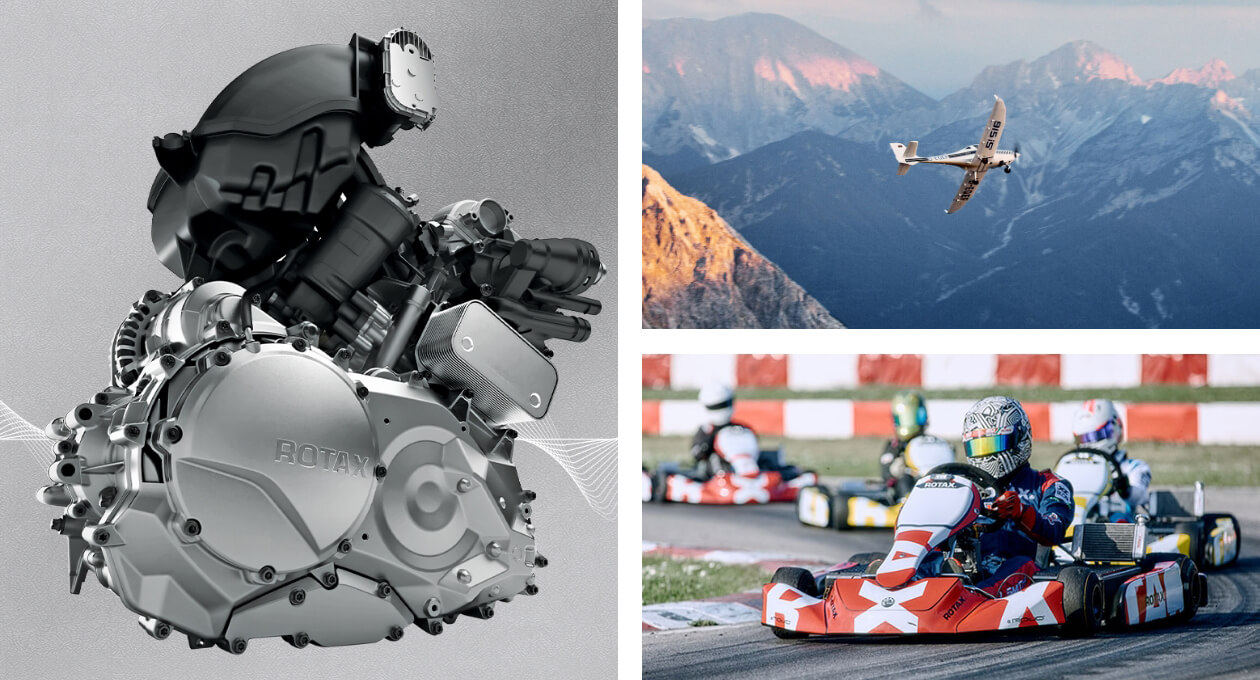
Rotax two-stroke aircraft engines often use CV carburetors, which automatically adjust the fuel mixture based on altitude:

40 years of Rotax aircraft engines


Last edited:

-They have installed millions of these carbs on their bikes with great results

-Honda has used them exclusively since the 1960's

For the Vintage Hondas we support: (GL1000, GL1100, GL1200, GL1500, DOHC-4s, CBX, CX500s, FT500, etc.) and any similar technology motorcycles


go to (click on bottom left of vid) or watch @ utube for a 25 vid playlist


Rotax two-stroke aircraft engines often use CV carburetors, which automatically adjust the fuel mixture based on altitude:

"Rotax two-stroke aircraft engines often use CV carburetors, which automatically adjust the fuel mixture based on altitude: "

That is false.

CV has no ability to compensate for altitude.

Rotax's patented DPM system does. Used on snowmobiles.
 
Last edited:
CV carbs does indeed compensate mixture for altitude

 
Last edited:
CV carbs does indeed compensate mixture for altitude


If you beleive your google-foo, explain how. In depth.
 
Could be talking about something like this

Back in the 1970’s a popular and inexpensive figment was a single carb conversion using a take off carburetor from I think a Harley Sportster. Available really cheap at swap meets. Anyone remember the details?
 
-Honda has used them ("CV carbs") exclusively since the 1960's
Actually honda used non-cv carbs on many bikes until at least 1977. I don't believe any of the sohc fours used cv carbs. The earliest Honda's I can recall with CV carbs are the 68 CB350s.

It is my understanding that emission requirements basically forced them to use CV carbs as direct slide carbs could not avoid undue rich conditions in certain circumstances.

I do not really like working on cv carbs but they definitely work well enough.
 
Back
Top