Timing Disc Plastic

Status
Not open for further replies.
Joined
Dec 28, 2009
Messages
5,557
Country flag
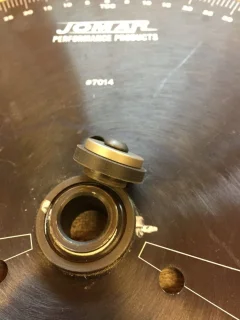
Just got my MCA (Aston Ltd. U.K.) white plastic , with red markings disc. No instructions. Should I call it a degree disc or a timing disc as stated on the bag. There is one quite small central hole. Any help appreciated on how to properly use it on my MK111 Norton.
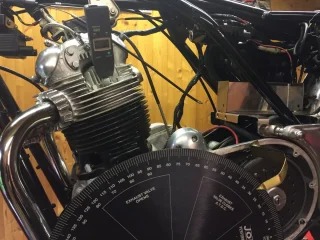
 
  • Your new degree wheel should be temporarily mounted to your crank.
  • We make a pointer from a bit of brass and mount it to one of the primary case bolt holes.
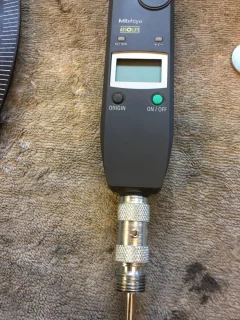
  • Then find top dead centre by inserting a dial indicator into the spark plug hole (I made a holder by stripping the guts out of an old spark plug).
  • There are many other ways to do this, from sticking a piece of wood into the spark plug hole through to a digital gauge
  • I look for the same measurement at 20 degrees before and after top dead centre, that way I can make sure I am not confusing things with any dwell or slop at TDC.
  • Once you know where your top dead centre measurement is, you can then wind the crank back to 29 degrees, or whatever you are going for.
  • Without moving anything, carefully take off your degree wheel and pointer, then replace the primary cover, remove the inspection cover and check to see if the timing marks tally with the line on the alternator rotor.
  • There is a small amount of adjustment on the ignition timing degree scale (loosen the posidrive self tappers and adjust on the slotted holes)

...there’s a very quick description of how I use a degree wheel - good luck!

Timing Disc Plastic

Timing Disc Plastic
 
Just got my MCA (Aston Ltd. U.K.) white plastic , with red markings disc. No instructions. Should I call it a degree disc or a timing disc as stated on the bag. There is one quite small central hole. Any help appreciated on how to properly use it on my MK111 Norton.

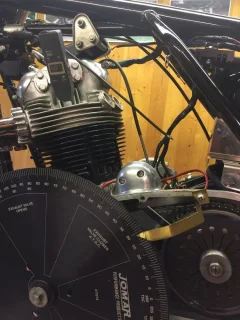
After you get your TDC set right rotate the engine to 28 degrees BTDC and look through the inspection plug on the right side of the engine. I put matching punch marks on the case and crank so I can check my timing indicator plate against actual 28 degrees BTDC.
Pete
 
Timing Disc Plastic
I have an adapter that one of our members was kind enough to send to me.
It screws into the rotor nut and a timing plate mounts to it. I’m not home right now so I don’t have a picture.


EDIT;
Just found a picture on my phone
 
Last edited:
That degree wheel looks well made and large enough to be very accurate. And it looks like the depth indicator mounted at the spark plug hole is electronic. Does it measure depth mechanically with a digital read out? Or is it somehow totally electronic, as in some sort of laser depth guage. Also, is there a web site where one can order that degree wheel? One other thing. This is just an "academic" question, I know, but I thought someone out there might have the answer at hand. Since there is a maximum connecting rod angle offset at 90 degrees BTDC of crank rotation (that, of course, is part of it being a crank in the first place) does the greatest vertical motion of the piston for a rotation of the crank still occur at 90 degrees, or at a point just above and below 90 degrees. Of course the least vertcal motion of the piston for a crank rotation would be at 0 degrees BTDC and at 180 degrees. Most accurate determination of crank rotation would be at that point of greatest vertcal motion of the piston. Just trying to overcomplicate the simple things in life, I know. But for some student out there it's just a bit of a Lagrange multiplier problem with some geometry thrown in. I just got a bit lazy. Maybe even some clear headed logic would give an easier answer.
 
It’s just the digital equivalent of the dial test indicator (DTI) gauge.

The pin on the end moves in and out, so it rests on the top of the piston.

You can see the spark plug holder we made for it in the attached pic.

Timing Disc Plastic

I have had the degree wheel for a long time. If memory serves me right, I bought it originally from Jegs- it was less than 20 bucks.

Mike Pemberton the Norton pushrod singles guru gave me a piece of good advice - get yourself the biggest one you can find because the bigger you go, the more accurate it will be and the less trouble you’ll have reading it when you get old!!!
 
A piston stop is more accurate. A dial indicator has a couple of degrees of inherent slop because at the top of the stroke the crank rotates and the piston does not move. Admittedly, for this sort of work on a late 1940's-era engine, it probably makes no difference at all. ;)

You can print a degree wheel from the internet and paste it on a CD. FWIW, the larger diameter the degree wheel, the more accurate. We used degree wheels on performance/competition motors that were 18" in diameter.
 
@MexicoMike that’s why I set my degree wheel both sides of TDC around 20 degrees off.
I make sure I have the same reading on the gauge both sides so it ensures I’m not working around the ‘inherent slop’ that you refer to.

My degree wheel is only 14 inches, so I guess you are the winner :)
 
I use a supermagnet to attach plastic disc to crank end, using care not to bump once zero'd. I like a magnet to clamp on wire indicator stable long enough to get'r done. Dynodave Comeau made some adapters for disc attaching ease secured by screw/threads. With head off just push jugs to BDC. I've used rubber tip air gun pressure to push to BDC as don't take much or may spin past BDC.
 
A piston stop is more accurate. A dial indicator has a couple of degrees of inherent slop because at the top of the stroke the crank rotates and the piston does not move. Admittedly, for this sort of work on a late 1940's-era engine, it probably makes no difference at all. ;)

You can print a degree wheel from the internet and paste it on a CD. FWIW, the larger diameter the degree wheel, the more accurate. We used degree wheels on performance/competition motors that were 18" in diameter.

In the spirit of "cut and try", would you set the piston stop at any reasonable depth point and then, rotating the other way to the same stop point, just set the degree wheel to read the same number of degrees in either direction.
 
Last edited by a moderator:
I think that's basically right but I think I pulled the stop when going from one side to the other because valves are opening and closing then and I was worried about them hitting the stop which was sticking down thru the spark plug hole.
 
Status
Not open for further replies.
Back
Top