Commando literature problem

Joined
Jan 9, 2020
Messages
37
Country flag

I read something the other day that there was some misinformation in this book. Can anyone confirm that and possibly point out the errors with page numbers?
I have no idea, but since you can download factory workshop manuals, why buy/use Haynes?


I think all available manuals have some incorrect or confusing info, but once you're used to the factory workshop, you'll be OK.
 
Not just errors but the bike that's rebuilt by Haynes is a (20M3S) Fastback so some of the information isn't applicable to earlier or later models as there were many changes made during Commando production.
 
BTW, parts manuals are also available, but I never use them for Norton these days. I find it much easier to use Andover Norton's online listings and generally, the numbers they provide are the numbers used today by sellers. Often the description of the part will show other equivalent numbers.

For instance, if working on a 1972 Commando: https://andover-norton.co.uk/en/shop-drawings/4

You can select the year from the dropdown.
 
Yes, I’ve been through that site being nosy and just looking at parts and cutaway drawings. Looks very informative.
 
I thought the Haynes manual was relatively error free. The factory workshop manual, ie, schematic of oil flow, was more problematic.
 
Workshop manual calls for 70 ft-lbs on rear axle nut, which leads to distortion of speedodrive box and the infamous Black Star of Death syndrome. OldBrits torque spec list recommends 45-50 ft-lbs.
Similar reduction for the gearbox sleeve gear nut torque i believe, else the clutch circlip get messed up.
 
Workshop manual calls for 70 ft-lbs on rear axle nut, which leads to distortion of speedodrive box and the infamous Black Star of Death syndrome. OldBrits torque spec list recommends 45-50 ft-lbs.
Similar reduction for the gearbox sleeve gear nut torque i believe, else the clutch circlip get messed up.
“Black Star of Death syndrome” ?
 
“Black Star of Death syndrome” ?
 
I use the workshop manual settings for both without any problems,
There are several versions of the workshop manual and only the MK3 gives a torque for the rear axle (as far as I know). If you are using 80 ft-lb, I'm confident that you're speedo drive is distorted or non-standard if a pre-MK3. Probably on a MK3 as well, but I haven't personally tested on a MK3.

I say this in my published torque document (I need to update it to make the pre-MK3/MK3 distinction):

Commando literature problem


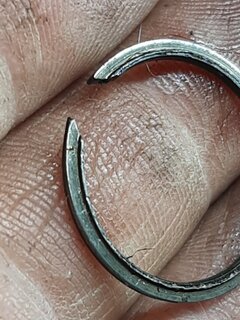
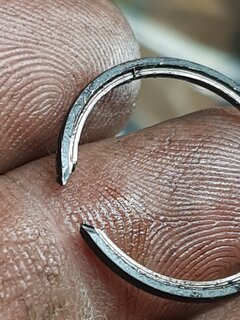
If the clutch location circlip holds then fine, but the workshop torque for that nut is overkill and the circlip doesn't always withstand it. I use 50 ft-lb. which is more than Old Britts specified and what Andover Norton specifies.

I say this:

Commando literature problem


See: https://www.gregmarsh.com/MC/Norton/Info/NortonTorque.aspx
 
If the clutch location circlip holds then fine, but the workshop torque for that nut is overkill and the circlip doesn't always withstand it.

Is this normal wear of that circlip or the result of an overtorque condition??
 

Attachments

  • Commando literature problem
    IMG_20250816_212059.jpg
    287.9 KB · Views: 47
  • Commando literature problem
    IMG_20250816_212111.jpg
    308.2 KB · Views: 47
I use the workshop manual settings for both without any problems,
And I've used the book values and had the problems stated...then switched to reduced torque and no such problem and many thousands of miles troublefree.
 
“Black Star of Death syndrome” ?
When the speedodrive gets deformed (actually begins to extrude out from under the spacer contact area) it comes into contact with the spinnkng aluminium hub cover plate where it starts machining away the material. This creates a lot of heat, which ends up melting any grease in the speedo drive housing, that then migratws out and onto the cover plate...forming the Black Star of Death pattern under centrafugal forces until it "re-freezes".
 
And I've used the book values and had the problems stated...then switched to reduced torque and no such problem and many thousands of miles troublefree.
Did you callibrate your torque wrench? Not trying to be clever, but I did find my torque wrench was significantly out (would have over-torqued) before it was checked and re-callibrated. It was fairly new at the time, but I'd had a problem with a car's head stud, so got it checked out.
 
Back
Top