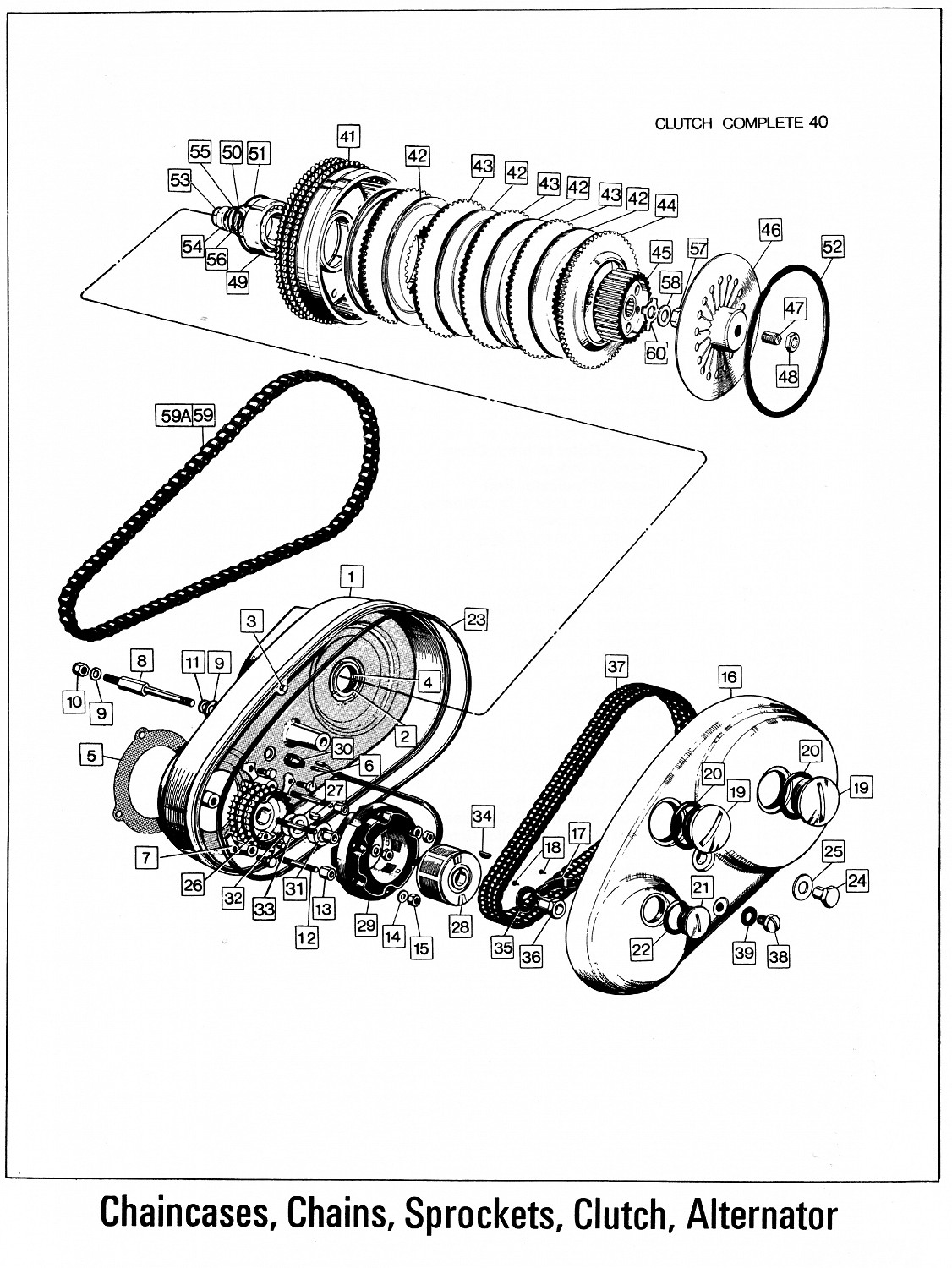
850 Clutch Diaphragm

Brewer

Basic
Joined
Oct 1, 2007
Messages
126
Country flag
Hi All,
I have problems with clutch slipping which has been ongoing. The clutch has been set as per spec with bronze plates and is quite easy to operate with the tension of the lever from the handle bars.
Is there a modification that a stiffer diaphragm could be installed?
 
Last edited:
Hi All,
I have problems with clutch slipping which has been ongoing. The clutch has been set as per spec with bronze plates and is quite easy to operate with the tension of the lever from the handle bars.
Is there a modification that a stiffer diaphragm could be installed?
Check your stack height it's probably too high
Are you using engine oil in the chain case?
I so change to ATF
 
Stack height too high (as Baz said).

Wrong oil (not wet clutch compatible).

Contaminated plates (old oil, possibly wrong oil, built up on plates).

Weakened diaphragm spring (old age, over enthusiastic use of compression tool, etc).

Incorrect pushrod or cable adjustment.
 
Last edited:
Stack height too high (as Baz said).

Wrong oil (not wet clutch compatible).

Contaminated plates (old oil, possibly wrong oil, built up on plates).

Weakened diaphragm spring (old age, over enthusiastic use of compression tool, etc).
Hi mate, I have always used ATF, I will check stack height. Could also be caused from an old diagphram? Is there a way of checking that?
Problem has arrived mostly from installing PWK Carbs which have provided more response and power. I wonder if the guys that have Installed FCR carbs are having issues with clutch slipp.
 
The original diaphragm spring is usually more than enough, reducing the stack height should give more grip at the epense of a heavier clutch action, have you fitted a thicker 3mm or 4mm plain plate by any chance, if you have then you might need to fit the original 2mm plate or you could try a new diaphragm. Are you sure the plates haven't become contaminated with gear oil that has migrated along the clutch pushrod tunnel?
 
The original diaphragm spring is usually more than enough, reducing the stack height should give more grip at the epense of a heavier clutch action, have you fitted a thicker 3mm or 4mm plain plate by any chance, if you have then you might need to fit the original 2mm plate or you could try a new diaphragm. Are you sure the plates haven't become contaminated with gear oil that has migrated along the clutch pushrod tunnel?
Hi L.A.B,
I have just rebuilt the engine and cleaned the bronze plates with brake clean prior to installation. I’m quite sure the friction plates are 2mm. Although I am suss about the diaphragm strength.
 
Its the top plate that's typically varied in thickness, its the last plate with the circular ridge.

850 Clutch Diaphragm


The other trick is to fit an extra plain steel plate so count them to see how many there are.

 
Hi mate, I have always used ATF, I will check stack height. Could also be caused from an old diagphram? Is there a way of checking that?
Problem has arrived mostly from installing PWK Carbs which have provided more response and power. I wonder if the guys that have Installed FCR carbs are having issues with clutch slipp.
The Colorado Norton Works clutch pack (essentially a Barnett clutch pack) and a belt clutch can take more power than a stock 850 is capable of producing. A dry belt clutch is a positive cure for oil clutch slip. I know you are asking for help with an oil clutch and I'm heading toward irrelevant.

I run 35mm FCRs on a 750 engine I built that I'm fairly certain would keep up with a stock 850 with PWK carburetion. The RGM belt clutch I'm using does not slip under acceleration and I have all the fancy light weight parts in the engine. I'm not gentle on the throttle either.

I've never measured the stack height. I have enough height to get the clip on with a spring compressor doing its thing, and that works for me. The RGM clutch has two steels at the rear. One of them is a fat one. Never actually measured it either. I'm very out of touch with my inner anal measuring procedures.

My only experience with oil clutch is with the early 3 spring ones and they always ended up slipping eventually. Curse of a tuner. The dry belt cutch after some trials and tribulations getting it fitted in a bike it was not designed for ended up being the ticket to curing clutch slip.
 
I don't think I've ever heard of a diaphragm wearing out or weakening.
Gear oil migrates down the clutch rod and fowls the plates.
ATF helps to clean it, but once the gear oil gets in the bronze, it's a mess.
New clutch plates and possible steels are the answer.
Here's your low cost fix, at least for awhile.
1. Disassemble and and thoroughly clean them in whatever spirits you wish.
2. Deglaze by flat sanding on a steel plate or glass or whatever with 320 grit wet or dry sandpaper.
This to both the plates and steels till everything is flat.
3. Thoroughly clean again.
4. Reassemble with Clutch Rod seal, if you can source one.
5. Store bike upright, not on side stand.
6. Do no overfill gear box.
Doing 5 and 6 minimizes the need for the Clutch Rod seal.
 
The diaphragm can wear out as my original one did many years ago and was causing it to go flat and cause the clutch to slip, I replaced the diaphragm and clutch centre at the same time, as well replaced the primary chain and I am still using my original bronze and steel plates, from when I brought my 74 Commando new (now in a Featherbed frame) have been using ATF oil since 1982 and I never over fill my gear box measured by a measuring cup, I also put grease on my clutch rod and have never had GB oil migrate to my primary, I have never checked my plate height in the 50 years of ownership and my clutch don't slip, I run a hot cam and head work with a shaved head, I have always ridden my Norton hard since I was 17 years old and I still ride the same as I have always ridden on all my bikes.
But I do regular maintenance with my clutch just to check that everything is good, but to be honest its been sometime since I been inside my primary, I ran Jims PWK carbs for about 11 years but always had the left carb problem with sticking float, not all the time but it drove me crazy trying to fix the problem by doing fixes Jim told me to do, I decided I had enough and gone back to my old Amals after a full service and unblock the pilot jet that gave me my original problem, my Amals are jetted for the work that has been done to my motor and to be honest the Amals perform better than the PWKs and they work so well with my Joe Hunt magneto.

Ashley
 
The clutch diaphram spring compession tool should not be left on for any extended period of time .
Best is to get in there , using it , do any repairs and then reassemble the clutch within a few days .
Don't leave the tool under compression for a long time , like going away for the winter etc.
 
If you have cleaned the bronze plates and think they are clean then use some ethanol petrol away from the house/garage/ workshop and in a aluminium pan to avoid sparking and clean them again and see what comes out of them, I was surprised. Other than that swap over to Barnett plates as they don't care if they are dry or in oil.
 
Put the bronze plates in the dishwasher !

Or, as madnorton says, just put a Barnet clutch pack in and be done with it.

I run Barnets in my 920 and 1007 and they’re perfect.
 
I use the bronze 850 plates in the clutch . They will eventually eat into the original clutch hub rendering it useless . That's why Colorado Norton Works hardened clutch center changed things for the better .
 
I use the bronze 850 plates in the clutch . They will eventually eat into the original clutch hub rendering it useless . That's why Colorado Norton Works hardened clutch center changed things for the better .
So are AN clutch centres, I had the material spec changed in 2016. The MK3 clutch centres, original and those made up until 2016, were actually case hardened but the material was the same as the earlier clutch centres which despite taking a case harden has a soft core, the new material takes a case harden and a has a tougher core.
 
I use the bronze 850 plates in the clutch . They will eventually eat into the original clutch hub rendering it useless . That's why Colorado Norton Works hardened clutch center changed things for the better .
Took 35 years of hard riding for the original clutch centre hub to chew out with over 120k miles on it so not to bad a run really, replacement centre was $74 that was 15 years ago from RGM and my clutch was still working when I replaced it, I am still using the original clutch plates and outer housing.
My clutch lever has always been a light pull from day one from new.

Ashley
 
Back
Top